

Innovation Ecosystems for the Bioeconomy Transition: Bioplastics, Reuse Models and Circular Start-up Systems in Bangladesh
Asia-Pacific’s transition to a sustainable bioeconomy requires greater attention to plastics as a fossil-dependent material system. Using Bangladesh as an emerging industrial case, this article examines how bio-based materials and reuse models can support wider industrial transformation. It argues that progress depends on innovation ecosystems that connect technology development, transfer, demonstration, finance and market adoption. Four pathways are considered: bio-based materials and industrial biotechnology, reuse and refill business models, Plastic-Tech hubs for testing and commercialisation, and finance for start-ups and small enterprises. The article also considers digital tools and regional cooperation as supporting mechanisms. Bangladesh’s experience reflects a broader Asia-Pacific challenge: renewable feedstocks and technical ideas are increasingly available, but the facilities, partnerships and financing needed to turn them into reliable products remain limited. Regional progress will hinge on strengthening the practical systems through which technologies are adapted, tested, financed and adopted by industry.
- bioeconomy
- bioplastics
- technology transfer
- reuse systems
- commercialisation
- innovation finance
- Bangladesh
- Asia-Pacific
1. Introduction: Plastics and the Bioeconomy Transition
Bioeconomy policy in Asia-Pacific has largely centred on agriculture, food systems, forestry and renewable energy. Materials deserve equal attention. Plastics are embedded in packaging, manufacturing, healthcare, construction, agriculture and consumer markets, yet most remain dependent on fossil feedstocks. Their environmental effects are well recognised (UNEP, 2023; OECD, 2022). The industrial question is less often addressed: how can economies reduce fossil dependence without sacrificing product performance, affordability or productive capacity?
This perspective places plastics within industrial transformation rather than treating them solely as a waste problem. It directs attention to feedstocks, processing technologies, product design and business viability, while recognising that alternative materials must compete within established supply chains and demanding consumer markets.
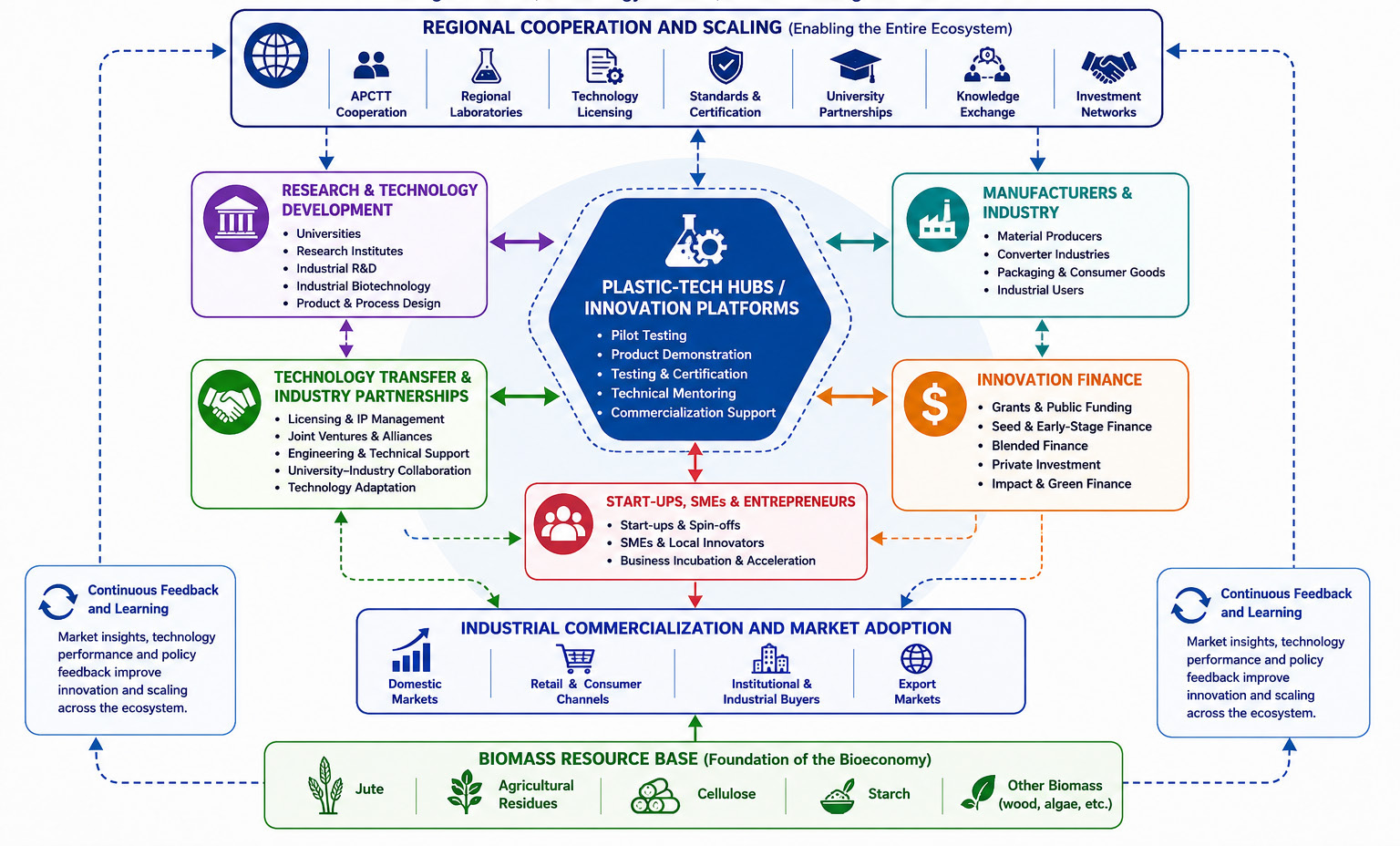
Innovation ecosystems connect renewable biomass with industrial commercialisation through research, technology transfer, finance and regional collaboration.
The transition to a sustainable bioeconomy will depend not only on renewable feedstocks but also on the capacity of countries to convert biological resources into competitive industrial materials. For plastics, this involves material science, industrial biotechnology, manufacturing capability and new business models. Reuse also belongs within this agenda because it changes how packaging is designed, circulated and retained in use.
In this article, an innovation ecosystem refers to the network of research institutions, technology providers, enterprises, investors and support platforms that enables new materials and production models to move from development to commercial application. Figure 1 sets out this ecosystem, showing how research, technology transfer, pilot testing, finance and market adoption connect around Plastic-Tech hubs and regional cooperation to reduce technical and commercial risk while supporting industrial adoption across Asia-Pacific economies.
This challenge is common across Asia-Pacific: India, Indonesia, Viet Nam and Malaysia each combine different strengths in biotechnology, natural fibres, manufacturing scale and research–industry links, yet all face similar constraints in linking scientific capability with production, testing, finance and market demand. Bangladesh reflects the same regional pattern. Its jute, starch resources, agricultural residues and manufacturing experience provide a credible base for selected bio-based products, but limited demonstration facilities, technical services and early-stage finance continue to restrict scale.
Public policy can support this process through standards, shared facilities, research partnerships and measures that reduce early technical risk. It cannot compensate for weak product performance or absent demand. The focus of this article is therefore on practical systems that improve technology uptake rather than on broad governance arrangements.
Four pathways follow: bio-based materials and industrial biotechnology; reuse and refill systems as business innovation; Plastic-Tech hubs for testing and commercialisation; and finance for start-ups and small enterprises. Digital tools and regional cooperation are treated as supporting mechanisms. Bangladesh is used as an illustrative industrial case, while the wider purpose is to identify lessons for Asia-Pacific economies seeking competitive bio-based industries.
2. Bangladesh’s Opportunity for Bio-Based Material Innovation
Across Asia-Pacific, agricultural fibres, starch crops, forestry products and food-processing residues provide a substantial resource base for bio-based materials. These feedstocks can support packaging, composites, coatings, films and other industrial products. Their value, however, varies by application. Material quality, seasonal availability, transport costs and compatibility with existing production systems all influence whether a resource can support a viable industry.
Bangladesh offers a useful illustration of this wider opportunity. Jute is its most established advantage. The country has longstanding experience in cultivation, fibre processing and product manufacture, together with a workforce and industrial base familiar with the material. Higher-value uses may include reinforced composites, moulded products and selected packaging applications in which low weight, renewable content and mechanical strength are commercially relevant. These products are unlikely to replace conventional polymers across all uses, but they may compete in defined market segments when quality, design and cost are properly controlled (Pickering et al., 2016).
Rice residues, sugarcane by-products, starch-bearing crops and cellulose from agricultural processing broaden the range of possible applications. Films, coatings, fillers and selected biodegradable materials are among the more relevant options. Yet commercial planning must begin with a realistic assessment of feedstock quality and supply. Moisture, contamination, seasonal fluctuations and collection costs can affect processing efficiency and product consistency. Broad estimates of biomass availability are therefore less useful than detailed evaluation of the feedstock required for a specific product (FAO, 2024; Lokko et al., 2018).
Industrial demand is equally important. Bangladesh’s packaging, textile, food-processing and consumergoods sectors could provide early users of bio-based materials. Existing firms understand production costs, machinery constraints and buyer requirements, while smaller enterprises can respond quickly to specialised demand. Their contribution will depend on access to engineering support, testing services and appropriately scaled production equipment rather than on the creation of entirely new industrial structures (Asian Development Bank, 2022).
Comparable opportunities exist across the region. India combines agricultural resources with stronger biotechnology and polymer research, although many products continue to face cost and scale constraints. Indonesia has abundant natural fibres and residues, but conversion into industrial materials depends on more reliable links between suppliers, processors and manufacturers. Viet Nam’s export-oriented industries create demand for materials that meet international technical and buyer requirements, giving testing and certification particular importance. Malaysia’s investment in biotechnology and research– industry collaboration shows how sustained technical support can help firms move into higher-value markets (OECD, 2021; ESCAP, 2022).
These cases point to different national strengths rather than a single model. India offers deeper scientific capacity, Indonesia a broad agricultural resource base, Viet Nam strong manufacturing links and Malaysia more developed biotechnology support. Bangladesh’s comparative advantage lies in jute, selected agricultural feedstocks and an established manufacturing sector. The practical task is to match those assets with product categories in which they can compete.
Market choice should also reflect end-of-life conditions. A material described as biodegradable may offer limited benefit where industrial composting or separate treatment is unavailable. Producers should therefore assess performance, cost and disposal conditions together before making environmental claims.
Focused value chains offer the most credible route forward. Bangladesh and other emerging Asia-Pacific economies are more likely to succeed by selecting a limited number of materials and applications, building dependable supply arrangements and proving their value in real industrial markets than by attempting to develop every available bio-based technology.
3. Bioplastics, Industrial Biotechnology and Technology Transfer
Bio-based plastics are frequently described as a single solution, although they represent a diverse group of materials with different feedstocks, production methods and performance characteristics. Some are manufactured partly or entirely from renewable biological resources, while others are designed to biodegrade under specific conditions. These distinctions matter because industrial adoption depends on product performance, manufacturing compatibility, production cost and end-of-life management rather than on feedstock origin alone (UNEP, 2023; European Bioplastics, 2024).
3.1 Local Material Pathways
Agricultural economies across Asia-Pacific already possess several feedstocks suitable for bio-based materials. Four pathways are particularly relevant. Jute can support reinforced composites and selected packaging products. Cellulose recovered from agricultural processing offers opportunities for films, coatings and fibre-based packaging. Starch can be used in bags, liners and other products where functional requirements remain modest. Agricultural residues can provide fillers or reinforcing materials in composite applications.
These pathways differ in commercial readiness. Jute composites already serve established industrial markets, whereas cellulose-based films and some starch-derived materials require further product development and testing. No single material is likely to replace conventional plastics across every application. Selection should therefore be guided by product performance, processing requirements, cost and market demand rather than by the expectation of a universal substitute (Pickering et al., 2016; Klemm et al., 2018).
3.2 Industrial Biotechnology Requirements
Industrial biotechnology provides the production systems that convert biological feedstocks into consistent industrial materials. Fermentation processes generate platform chemicals for polymer production, enzyme technologies improve feedstock conversion, and integrated biorefineries increase resource efficiency by producing several valuable products from the same biomass stream (Cherubini, 2010; Koutinas et al., 2014).
Scientific discovery alone is not sufficient for industrial success. Technologies must operate reliably beyond the laboratory, using variable agricultural feedstocks while maintaining consistent product quality. For many emerging economies, scaling production at competitive cost matters more than developing entirely new scientific breakthroughs (Lee et al., 2019; UNIDO, 2022).
Applied technical capacity therefore deserves priority. Firms need access to pilot-scale processing, material compounding and performance testing so that products can be evaluated under realistic manufacturing conditions. These facilities reduce technical uncertainty before substantial private investment is committed.
3.3 Technology Transfer Mechanisms
Many Asia-Pacific economies will continue to obtain bio-based technologies through international collaboration rather than domestic invention alone. Licensing agreements provide access to proven production methods. Joint ventures combine external technologies with local manufacturing capability. University–industry partnerships support product adaptation, technical testing and workforce development. Each pathway can shorten the time required to introduce new materials into commercial production.
Effective technology transfer extends beyond equipment purchase. Imported production systems deliver little value unless firms can adapt them to local feedstocks, manufacturing conditions and market requirements. Technical training, product testing and engineering support should therefore accompany any transfer arrangement so that technologies can be modified and operated successfully under local conditions (UNCTAD, 2023; ESCAP, 2022).
Testing and certification play an equally important role. Manufacturers and buyers require confidence that new materials satisfy performance, quality and safety requirements before they are incorporated into production systems. Shared laboratories and regional testing facilities can provide these services more efficiently than duplicating specialised infrastructure in every country — a point developed further, alongside the role of the Asian and Pacific Centre for Transfer of Technology (APCTT), in Section 7.
Bangladesh illustrates this broader regional challenge. Technologies suited to jute, cellulose and starchbased materials are already available internationally, but successful adoption depends on combining technology partnerships with domestic engineering capability, pilot testing and product development. Industrial capability is created when imported knowledge is adapted to local production systems and accepted by manufacturers.
4. Reuse and Refill Systems as Business Innovation
Bio-based materials reduce dependence on fossil feedstocks by changing what products are made from. Reuse addresses the same objective by changing how products are delivered. Rather than producing a new package for every sale, reuse systems keep containers in circulation through repeated collection, cleaning and redistribution. Their success depends less on new materials than on efficient business operations.
Returnable beverage bottles and transport packaging have operated successfully for many years across Asia-Pacific. Bangladesh also retains formal and informal systems in which glass bottles, crates and other containers circulate between distributors, retailers and consumers. These established practices demonstrate that reuse is not a new concept. The commercial challenge is to adapt familiar models to modern retail formats, higher product safety standards and increasingly complex supply chains.
Packaging design is central to business performance. Containers must withstand repeated handling, transport and washing without losing quality. Standardised designs can lower costs because different producers or retailers can use the same collection and cleaning systems. Deposit-return arrangements can improve recovery rates when the financial incentive is sufficient to encourage returns while remaining convenient for customers.
Efficient reverse logistics determines whether reuse remains commercially viable. Delivery vehicles can collect empty containers during return journeys, while retailers or wholesalers can serve as collection points. Urban markets often provide the greatest opportunity because transport distances are shorter and container turnover is faster. Successful systems are therefore designed around existing distribution networks rather than copied directly from other countries (Ellen MacArthur Foundation, 2019; OECD, 2020).
Ownership of reusable packaging can also shift from product manufacturers to specialised service providers. Companies responsible for container supply, cleaning and redistribution recover their investment through repeated circulation rather than one-time sales. This approach reduces the capital burden on producers, particularly smaller firms that cannot justify dedicated return systems.
Regional experience illustrates the flexibility of this business model. Indonesia has expanded refill systems for household products through retail networks. India is testing reusable packaging across several consumer-product sectors. Thailand has promoted reuse as part of its broader Bio-Circular-Green (BCG) Economy Model (UNEP, 2021; Asian Development Bank, 2025; Royal Thai Government, 2023).
Bangladesh’s most practical opportunities are likely to involve products with frequent purchasing cycles, stable distribution channels and limited packaging variation, including beverages, household products and business-to-business transport packaging. Decisions should be guided by operating costs, return rates, washing requirements and customer convenience. Where these conditions are favourable, reuse can complement bio-based materials by lowering demand for single-use packaging while creating commercially viable service models.
5. Plastic-Tech Hubs and Commercialisation Pathways
Many promising material technologies do not fail because of weak science. They fail because they cannot progress from laboratory results to reliable industrial production. Manufacturers need evidence that a new material can be produced consistently, comply with standards, operate on existing
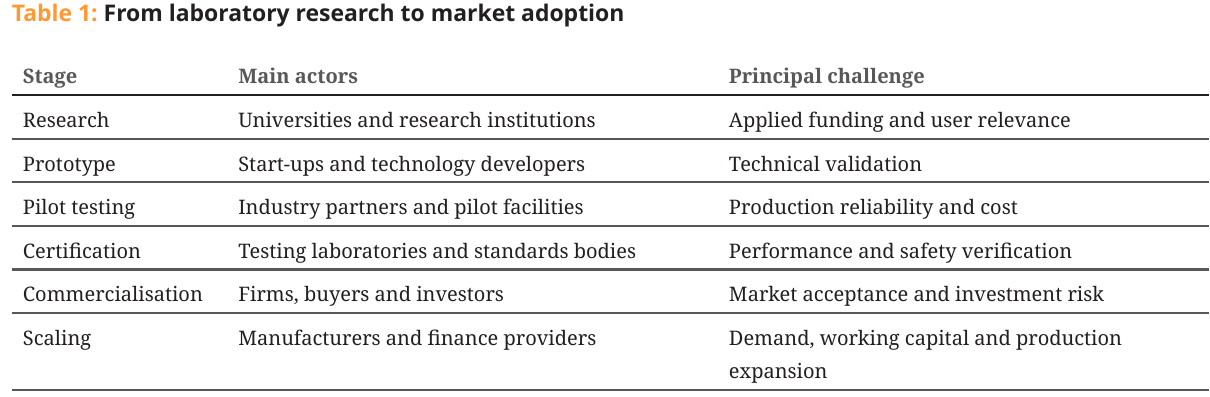
equipment and satisfy market requirements. Generating that evidence requires facilities, technical expertise and commercial support that many universities and small enterprises cannot provide on their own.
Plastic-Tech hubs are innovation platforms that combine laboratories, pilot facilities, testing services, entrepreneurship support and industry partnerships for sustainable material technologies. They are not regulatory institutions. Their purpose is to provide practical services that reduce technical uncertainty and help promising technologies progress towards commercial production.
Commercialisation follows a sequence in which each stage presents a different challenge. Research generates new ideas but must remain connected to industrial demand. Prototypes demonstrate technical feasibility. Pilot production confirms whether a process performs reliably under realistic operating conditions. Certification establishes compliance with recognised standards, while commercialisation and scaling depend on customer confidence, investment and production capability.
Early industrial involvement makes research more valuable. Material developers need to understand manufacturing requirements, processing conditions and market expectations before technologies reach the pilot stage. Regular interaction with manufacturers helps direct research towards applications with realistic commercial potential rather than technically successful products that lack industrial demand.
Pilot facilities provide the critical bridge between research and manufacturing. Small production runs allow engineers to refine formulations, optimise processing conditions and evaluate performance before large investments are made. For bio-based materials, pilot testing can identify practical issues such as feedstock variability, moisture sensitivity, colour consistency and equipment compatibility that are rarely evident under laboratory conditions. Reliable pilot data also reduces technical risk for manufacturers and investors (UNIDO, 2022; Lokko et al., 2018).
The next stage of commercialisation is testing and certification. Packaging, construction materials and consumer products must demonstrate compliance with recognised performance and safety standards before entering the market. Independent testing increases buyer confidence and supports access to domestic and export markets. Plastic-Tech hubs should therefore work through existing accredited laboratories and standards organisations rather than establishing parallel certification systems (UNEP, 2023).
Practical business support matters just as much. Start-ups and technology developers often require assistance with product costing, intellectual property management, licensing, customer trials and supplier relationships. Technical mentoring and industry partnerships are generally more valuable than generic business training because they address the operational barriers that determine whether a technology reaches commercial production.
These services do not require new institutions to work in Bangladesh’s case. Existing universities, engineering centres, industrial clusters and sector-specific research organisations could provide complementary facilities linked through a coordinated service network. This distributed approach would make better use of existing expertise while limiting new infrastructure costs.
Not every innovation should receive the same level of support. Pilot facilities and commercialisation services should concentrate on technologies that demonstrate technical feasibility, reliable feedstock supply, clear market demand and a realistic pathway to standards compliance. Careful project selection allows limited resources to produce stronger commercial outcomes.
Commercialisation also benefits from regional collaboration, since neighbouring economies hold complementary strengths in biotechnology, manufacturing and testing that Section 7 examines in more detail. Shared access to specialised facilities, technical expertise and industrial partnerships can reduce costs and accelerate market entry for emerging technologies. Progress should be measured by successful pilot trials, certified products, technology licensing, industrial adoption and investment mobilised rather than by the number of participating organisations.
Plastic-Tech hubs therefore perform a practical function within the innovation ecosystem. They help transform promising research into technologies that manufacturers, investors and customers are prepared to adopt with confidence.
6. Financing Innovation and Start-up Growth
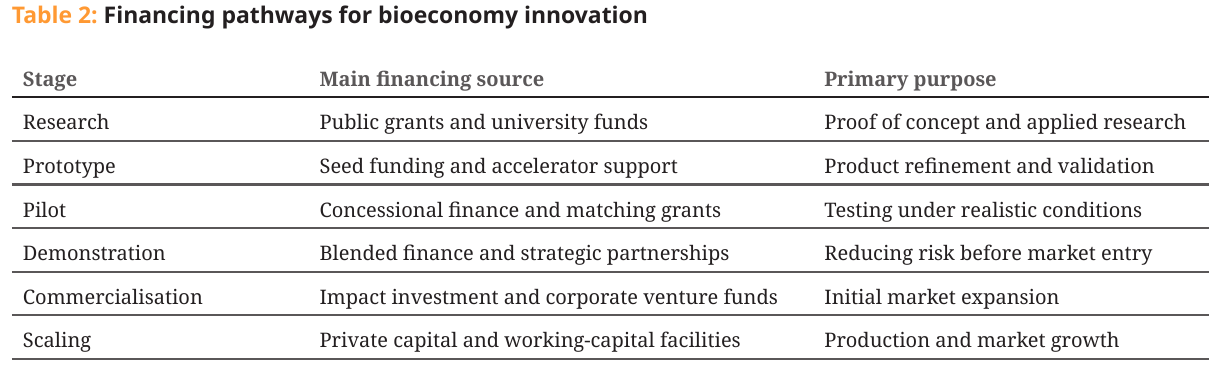
Successful commercialisation depends as much on appropriate finance as on good technology. An unproven bio-based material, refill service or pilot production line rarely fits conventional bank lending because technical uncertainty remains high and commercial returns have yet to be demonstrated. At the same time, grant funding alone cannot support long-term industrial growth. As a result, financing needs to evolve with the maturity of the technology, combining public support during early development with increasing private investment as technical and commercial risks decline.
A staged financing approach reflects this progression. Research grants help establish proof of concept and applied experimentation. Seed finance enables start-ups to refine prototypes, recruit technical expertise and engage potential customers. Concessional finance and matching grants support pilot production where technical feasibility has been demonstrated but commercial risks remain significant. Blended finance can reduce investment risk during demonstration, while impact investors, corporate venture funds and private capital become more appropriate once products have entered the market (OECD, 2023; Asian Development Bank, 2024).
Selecting projects is as important as providing finance. Funding decisions should consider technical feasibility, market demand, feedstock availability, progress towards certification and the capability of the development team. Linking financial support to agreed milestones—such as prototype completion, successful pilot production or verified customer trials—helps direct resources towards technologies that continue to demonstrate commercial potential while maintaining accountability for public investment.
The largest financing gap in many emerging economies occurs between successful laboratory research and commercial production. Pilot equipment, testing, engineering services and customer validation require substantial investment, yet commercial lenders often regard these activities as too risky. The pilot facilities described in Section 5 lower these costs, but enterprises still need finance to complete demonstration, product testing and early market development. Combining concessional loans, matching grants and industry contributions offers a practical way to spread these costs (UNIDO, 2022).
Once technical performance has been demonstrated, many enterprises face a different challenge: financing production and market expansion. Working capital is often needed to purchase raw materials, fulfil orders and manage payment delays. Credit guarantees, purchase-order finance and supplier credit can be more valuable at this point than additional research grants. Public procurement can also support early demand where products meet recognised performance and value-for-money requirements.
These financing needs are not unique to Bangladesh. Small and medium enterprises across many Asia-Pacific economies require modest financial instruments linked with technical mentoring, market access and commercialisation support rather than large stand-alone funding programmes. Larger manufacturers, in contrast, are more likely to invest when pilot results, testing data and customer demand have already reduced commercial uncertainty.
Finance is most effective when it operates alongside commercialisation services. Investors gain confidence when technologies have passed credible testing, received technical mentoring and established links with industrial partners. Funding mechanisms should therefore work closely with Plastic-Tech hubs, accelerators and industry associations so that capital becomes available when technologies are ready to progress to the next stage of development.
7. Digital Technologies and Regional Cooperation
Digital technologies can strengthen bioeconomy innovation by making technologies, expertise and markets easier to access. Their greatest value lies in supporting technology transfer and commercialisation rather than becoming objectives in themselves. For most Asia-Pacific economies, practical digital tools that reduce information gaps are likely to deliver greater benefits than highly sophisticated systems that are costly to establish and maintain.
Technology databases can help enterprises identify available production processes, equipment suppliers, testing laboratories, certification services and licensing opportunities. This is particularly valuable for small and medium enterprises that lack dedicated research and development capacity. Regional platforms can also provide information on technology readiness, feedstock requirements and potential industrial partners, allowing firms to assess suitable options before committing significant investment.
Digital product passports and QR-based traceability systems can improve transparency across material value chains by recording feedstock origin, material composition, certification status and recommended applications. Similar technologies can support inventory management and container tracking in reuse and refill systems. Simple, interoperable data standards and low-cost digital identifiers are likely to be more practical for emerging economies than complex proprietary platforms requiring extensive maintenance (ESCAP, 2024; UNIDO, 2022).
Artificial intelligence and material informatics can assist with feedstock screening, material design and performance prediction, but they remain supporting technologies rather than primary drivers of industrial transformation. Their effectiveness depends on reliable datasets, technical capability and continued investment in research. For many emerging economies, immediate gains are more likely to come from improving digital access to technical knowledge, testing facilities and industrial networks than from advanced automation alone (Lee et al., 2019; OECD, 2023).
Few countries need to develop every capability independently, which is where regional cooperation can do the most good. Shared laboratories for polymer characterisation, biodegradation assessment and food-contact testing can reduce investment costs while improving access to specialised expertise. Mutual recognition of testing and certification can lower barriers to regional trade, and university partnerships, technology licensing and collaborative research can accelerate technology adaptation and workforce development.
The region already demonstrates complementary strengths. Thailand has advanced bio-based materials through its BCG Economy Model. Malaysia has strengthened biotechnology and research–industry collaboration. India combines scientific capability with a large domestic market, while Viet Nam provides strong manufacturing links to regional supply chains. Bangladesh contributes expertise in natural-fibre products together with an established manufacturing base that can support wider regional value chains (Royal Thai Government, 2023; ESCAP, 2024).
APCTT can strengthen these regional connections through technology databases, expert networks, technology matching and collaboration between research institutions and industry. The practical objective is straightforward: enable enterprises to identify appropriate technologies, connect with technical partners, obtain testing and certification services, and reach regional markets more efficiently. Regional cooperation is most valuable when it shortens the path from promising innovation to commercial adoption.
8. Conclusion
The transition to a sustainable bioeconomy is, at bottom, an industrial transformation rather than solely an environmental objective. Bio-based polymers, natural-fibre composites and reuse systems can reduce dependence on fossil resources while creating new manufacturing and business opportunities. Their success, however, depends less on the availability of biomass than on the ability of firms to develop products that satisfy technical standards, compete in the marketplace and operate reliably at commercial scale.
Bangladesh illustrates a broader Asia-Pacific challenge. Many emerging economies possess renewable feedstocks, established manufacturing sectors and growing technical capability, yet they continue to face similar barriers. Technology development often remains disconnected from industrial demand. Pilot and testing facilities are limited, technology transfer is uneven, and financing is rarely aligned with the stages of commercialisation. These constraints slow the movement of promising innovations from research to competitive production.
The experience discussed in this article suggests that the priority is not to create entirely new technologies but to strengthen the systems that enable existing technologies to succeed. Focused material value chains, effective technology-transfer partnerships, pilot and testing facilities, trusted certification services, commercialisation support and stage-appropriate finance all contribute to stronger innovation ecosystems. Plastic-Tech hubs can bring these functions together through practical technical services, while reuse models provide an additional pathway by improving the efficiency of packaging systems rather than relying solely on new materials.
Regional cooperation can further accelerate progress through shared laboratories, technology licensing, university partnerships, common standards and APCTT-supported knowledge exchange. The principal challenge for many Asia-Pacific economies is therefore no longer the absence of promising bio-based technologies. It is building the technical capability, industrial partnerships and commercialisation pathways that allow those technologies to reach competitive markets. Progress is likely to come through a small number of well-tested, commercially successful innovations that demonstrate practical value and encourage wider industrial adoption across the region.
Acknowledgement
This research was undertaken as part of the development of the Industry Covenant on Plastic Waste and Plastic Management in Bangladesh (2025–2035) under the UNIDO project “Integrated Approach Towards Sustainable Plastics Use and Marine Litter Prevention in Bangladesh”. Financial support for the project was provided by the Government of Norway.
References
1. Asian Development Bank. (2022). Asia Small and Medium-Sized Enterprise Monitor 2022: Volume I— Country and Regional Reviews. Manila: Asian Development Bank.
2. Asian Development Bank. (2024). Asian Economic Integration Report 2024: Decarbonizing Global Value Chains. Manila: Asian Development Bank.
3. Asian Development Bank. (2025). Advancing the Circular Economy: Creating a Sustainable Future in Asia and the Pacific. Manila: Asian Development Bank.
4. Cherubini, F. (2010). The biorefinery concept: Using biomass instead of oil for producing energy and chemicals. Energy Conversion and Management, 51(7), 1412–1421.
5. Ellen MacArthur Foundation. (2019). Reuse: Rethinking Packaging. Cowes: Ellen MacArthur Foundation.
6. European Bioplastics. (2024). Bioplastics Market Development Update 2024. Berlin: European Bioplastics Association.
7. Food and Agriculture Organization of the United Nations. (2024). Bioeconomy for sustainable food and agriculture: a global opportunity, Position paper. Rome: FAO.
8. Klemm, D., Cranston, E. D., Fischer, D., et al. (2018). Nanocellulose as a natural source for groundbreaking applications in materials science: Today’s state. Materials Today, 21(7), 720–748.
9. Koutinas, A. A., Vlysidis, A., Pleissner, D., et al. (2014). Valorization of industrial waste and by-product streams via fermentation for the production of chemicals and biopolymers. Chemical Society Reviews, 43(8), 2587–2627.
10. Lee, S. Y., Kim, H. U., Chae, T. U., et al. (2019). A comprehensive metabolic map for production of biobased chemicals. Nature Catalysis, 2(1), 18–33.
11. Lokko, Y., Heijde, M., Schebesta, K., Scholtès, P., Van Montagu, M., & Giacca, M. (2018). Biotechnology and the bioeconomy—Towards inclusive and sustainable industrial development. New Biotechnology, 40, 5–10.
12. Organisation for Economic Co-operation and Development. (2020). Improving Resource Efficiency and the Circular Economy. Paris: OECD Publishing.
13. Organisation for Economic Co-operation and Development. (2021). The Bioeconomy and the Transition to a Sustainable Future. Paris: OECD Publishing.
14. Organisation for Economic Co-operation and Development. (2022). Global Plastics Outlook: Economic Drivers, Environmental Impacts and Policy Options. Paris: OECD Publishing.
15. Organisation for Economic Co-operation and Development. (2023). OECD Science, Technology and Innovation Outlook 2023: Enabling Transitions in Times of Disruption. Paris: OECD Publishing.
16. Pickering, K. L., Efendy, M. G. A., & Le, T. M. (2016). A review of recent developments in natural fibre composites and their mechanical performance. Composites Part A: Applied Science and Manufacturing, 83, 98–112.
17. Royal Thai Government. (2023). Bio-Circular-Green Economic Model (BCG): Thailand’s Strategy for Sustainable Development. Bangkok: Royal Thai Government.
18. United Nations Conference on Trade and Development. (2023). Technology and Innovation Report 2023: Opening Green Windows. Geneva: UNCTAD.
19. United Nations Economic and Social Commission for Asia and the Pacific. (2022). Science, Technology and Innovation for Sustainable Development in Asia and the Pacific. Bangkok: ESCAP.
20. United Nations Economic and Social Commission for Asia and the Pacific. (2024). Asia-Pacific Innovation Report 2024: Fostering Innovation for Sustainable Development. Bangkok: ESCAP.
21. United Nations Environment Programme. (2021). Addressing Single-use Plastic Products Pollution Using a Life Cycle Approach. Nairobi: UNEP.
22. United Nations Environment Programme. (2023). Turning off the Tap: How the World Can End Plastic Pollution and Create a Circular Economy. Nairobi: UNEP.
23. United Nations Industrial Development Organization. (2022). Industrial Development Report 2022: The Future of Industrialization in a Post-Pandemic World. Vienna: UNIDO.
Technology offer
Interested in this technology?
Request further information or explore potential cooperation with the technology provider.
Technology request
Can you help meet this technology need?
Share a relevant technology, expertise or partnership opportunity with APCTT.