
The Missing Provenance Layer: Patent Disclosure, Genetic Resources and Commercialisation Readiness for Australia’s Bioeconomy


Australia’s bioeconomy opportunity is often framed through scientific capability, patenting, investment and scale-up infrastructure. Yet for bio-based innovation involving native plants, microbial resources, biological materials, digital sequence information or associated Indigenous Knowledge, a further layer is becoming commercially decisive: provenance readiness. This article argues that provenance readiness should be treated as technology-transfer infrastructure for the Asia-Pacific bioeconomy. Using Australia as a country case study, it examines how patent disclosure, access and benefit-sharing, Indigenous Knowledge policy and digital sequence information governance are reshaping commercialisation practice. It also uses selected patent examples to show what patent documents disclose, and what they often leave invisible, about biological source, material access and benefit-sharing. The article proposes a practical checklist for universities, start-ups, MSMEs, public research organisations and policymakers seeking to move bio-based innovation into responsible regional markets.
- bioeconomy
- patent disclosure
- genetic resources
- traditional knowledge
- technology transfer
- access and benefit-sharing
- digital sequence information
- Australia
- Asia-Pacific
1. Introduction: Why does provenance now matter?
The Asia-Pacific bioeconomy is increasingly moving from policy aspiration to practical implementation. Across the region, biological resources, biological processes and bio-based innovations are being positioned as pathways to produce food, energy, materials and services more sustainably. This transition is unfolding against a broader backdrop of climate change, biodiversity loss, resource depletion, foodsystem pressure and uneven development. In response, governments and regional institutions are placing greater emphasis on innovation systems, technology transfer, financing mechanisms, capacitybuilding and regional cooperation to support the responsible deployment of bio-based technologies. ESCAP Resolution 82/2 reflects this shift by supporting the transition towards a sustainable bioeconomy in Asia and the Pacific and calling for stronger innovation, finance and regional capabilities (Economic and Social Commission for Asia and the Pacific [ESCAP], 2026). The central policy question is therefore no longer whether biotechnology can contribute to sustainable development, but how bio-based innovation can be translated into commercially viable, socially responsible and regionally useful outcomes across countries with different institutional, technological and market capacities.
This article argues that one layer of that deployment pathway remains underdeveloped: provenance readiness. In conventional technology-transfer practice, commercialisation readiness is usually assessed through patentability, ownership, freedom to operate, market opportunity, regulatory pathway, investment case and technical validation. While these questions remain essential, bioeconomy innovation often depends on biological resources, native plants, microbial strains, biological samples, sequence information, data sets, plant varieties, Indigenous Knowledge or community-held knowledge. For those
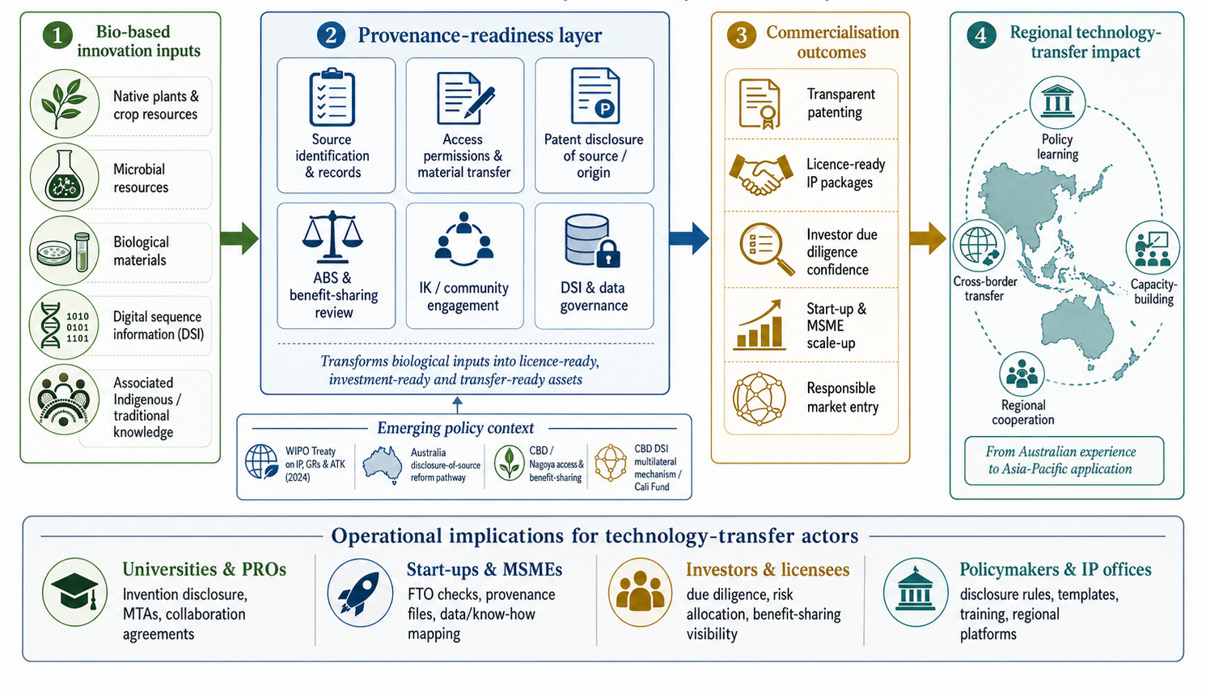
Bio-based innovation inputs become commercially transferable only after a provenance-readiness layer translates source, access, disclosure, ABS, Indigenous Knowledge and DSI/data governance into licence-ready, investment-ready and transfer-ready assets.
assets, the question is not only whether the invention is new or inventive. The question is whether the innovator can explain where the biological input came from, how it was accessed, what permissions apply, whether benefit-sharing expectations have been considered, how any associated Indigenous or traditional knowledge has been handled, and whether the resulting IP package is credible for licensing, investment and cross-border transfer.
Provenance readiness is therefore proposed here as a practical technology-transfer concept. It means the ability to identify, document, verify and disclose the biological and knowledge inputs that underpin a bio-based innovation, and to translate that information into patent strategy, contractual governance, investor due diligence and responsible market entry. It is a missing layer because it often sits between research compliance and commercial deal-making. Research teams may have ethics approvals, permits or collection records. Patent attorneys may draft claims around extracts, compounds, formulations, processes or engineered biological systems. Investors may review IP title and freedom to operate. Yet the chain connecting biological source, lawful access, knowledge contribution, patent disclosure and benefitsharing is frequently not built as a coherent commercialisation asset.
Australia provides a useful case study for this argument. It is a biodiversity-rich economy with strong research capability, an active university technology-transfer system, growing interest in synthetic biology and plant science, and live policy developments on genetic resources and Indigenous Knowledge. It also sits in the Asia-Pacific region, where many economies face similar tensions between biodiversity-based opportunity, uneven research capacity, digital sequence information, Indigenous and local-community rights, and the need to support start-ups and MSMEs. The article therefore uses Australia as a practical policy laboratory from which broader lessons can be drawn.
2. From patentability to provenance readiness
Patentability has long been central to biotechnology commercialisation. A patent may help a public research organisation or start-up attract investment, define a protectable market position and negotiate a licence. But in the bioeconomy, patentability is only one part of the asset. A biologically derived product may also depend on a material transfer agreement, a plant collection permit, a microbial strain deposit, cultivation know-how, sequence data, extraction protocols, analytical data, Indigenous or traditional knowledge, or confidential scale-up information. Each of these components may affect whether the
technology can be transferred. A patent can describe an invention sufficiently for patent-law purposes while saying little about the provenance records needed for access and benefit-sharing due diligence.
The distinction matters because technology transfer is a process of risk translation. A university or public research organisation converts research outputs into assets that another party can adopt, develop, finance, manufacture or sell. The transferee, whether a start-up, established company, community enterprise or overseas licensee, will ask practical questions. Who owns the invention? Are the claims supported? Are there third-party rights? Was the material collected lawfully? Can the material be transferred to another jurisdiction? Did the research use genetic resources or associated traditional knowledge? Does the patent application trigger a disclosure obligation? Are there ongoing obligations to access providers or communities? Can the product be developed for commercial use if the original collection was for non-commercial research only? These questions may not defeat the science, but they can delay or derail a deal.
Provenance readiness should not be seen as a substitute for patents but as a complement to them. In an ideal commercialisation workflow, the provenance file would sit alongside the invention disclosure, patentability assessment, freedom-to-operate review, data package, regulatory plan and financial model. It would record the biological material, source location where appropriate, access provider, collection authority, permit status, transfer chain, contractual restrictions, Indigenous Knowledge or community engagement issues, digital sequence information use and patent disclosure implications. Where information is unavailable, it would record the reasonable efforts made to identify it and the risk allocation proposed.
This is especially important for Asia-Pacific start-ups and MSMEs. Larger companies often have specialist regulatory, IP and compliance teams. Smaller firms may inherit university materials, published sequences, culture collection strains, plant extracts, research collaboration outputs or historical samples without a complete documentary chain. If provenance questions arise only during investment due diligence or licence negotiation, the practical options may be limited. Provenance readiness should therefore be treated as upstream infrastructure, not downstream repair.
3. Australia as a country case study
Australia’s case is analytically valuable for three reasons. First, it combines biodiversity-based opportunity with strong commercial research capability. The Australian Government states that genetic resources from plants, animals and microorganisms are valuable in developing speciality enzymes, enhanced genes and small molecules, with uses across crop protection, drug development, specialised chemicals and industrial processing (Department of Climate Change, Energy, the Environment and Water [DCCEEW], 2026a). These are precisely the kinds of applications that the regional bioeconomy seeks to expand. Australia is also one of the world’s megadiverse countries and has high levels of endemism, making biological-resource governance commercially and culturally significant (DCCEEW, 2026c).
Secondly, Australia has a fragmented but functioning access and benefit-sharing landscape. The Commonwealth, states and territories have different laws and processes for access to biological resources, depending on where biological samples are collected. Commonwealth areas are regulated under federal legislation and permits may be required, while states and territories operate their own systems (DCCEEW, 2026a). Australia is a party to the Convention on Biological Diversity (CBD) but is not currently a party to the Nagoya Protocol, which implements the CBD’s access and benefit-sharing objectives for genetic resources (CBD, 2010; DCCEEW, 2026a). The Australian Government nevertheless states that its domestic measures are consistent with the Protocol (DCCEEW, 2026a). For commercial or potentially commercial access to biological resources in Commonwealth areas, a benefit-sharing agreement must be used, and the Minister must be satisfied that it was made with prior informed consent of access providers (DCCEEW, 2026b).
Thirdly, Australia is actively considering reforms concerning patent disclosure of genetic resources and Traditional Knowledge. IP Australia’s Enhance and Enable Indigenous Knowledge consultations identified declaring the source of Indigenous Knowledge in new inventions and plant varieties as one possible reform to encourage transparency and recognition of Indigenous Knowledge owners (IP Australia, 2022). IP Australia now states that there is currently no requirement in the patent or plant breeder’s rights
system for applicants to disclose that they have used genetic resources or Traditional Knowledge in their inventions, or to disclose how and where they obtained those resources or knowledge (IP Australia, 2026). Australia signed the World Intellectual Property Organization (WIPO) Treaty in December 2024, and IP Australia is considering options to require patent applications to include disclosure of the source of genetic resources and Traditional Knowledge, with similar requirements potentially considered for plant breeder’s rights (IP Australia, 2025; IP Australia, 2026).
These policy settings make Australia a useful microcosm of the broader Asia-Pacific challenge. Many countries in the region are rich in biological resources and associated knowledge, but differ in patentoffice capacity, ABS implementation, technology-transfer maturity, bioinformatics capability and research funding. A practical Australian case study can show how provenance readiness might be built into technology-transfer practice before disputes arise. It can also show why disclosure rules, although important, are not enough. Disclosure is a patent-system trigger; provenance readiness is a broader commercialisation capability.
4. The emerging international disclosure and benefit-sharing environment
The international environment has changed rapidly since 2024. The WIPO Treaty on Intellectual Property, Genetic Resources and Associated Traditional Knowledge was adopted on 24 May 2024 after more than two decades of negotiations (World Intellectual Property Organization [WIPO], 2024b). WIPO explains that the Treaty aims to enhance the efficacy, transparency and quality of the patent system in relation to genetic resources and associated traditional knowledge, and to prevent patents being granted erroneously for inventions that are not novel or inventive in light of such resources or knowledge (WIPO, 2024a). The Treaty establishes a mandatory disclosure requirement where claimed inventions are based on genetic resources or associated traditional knowledge. Applicants must disclose the country of origin of the genetic resources and/or the Indigenous Peoples or local community providing the associated traditional knowledge, where that information is known. If not known, the source must be disclosed, or the applicant must declare that the information is not known (WIPO, 2024a).
The Treaty is procedurally cautious but symbolically important. It does not create new substantive rights in genetic resources or traditional knowledge. It does not by itself require benefit-sharing. It also provides that, fraud aside, failure to disclose should not be the sole basis for revoking or rendering unenforceable a patent (WIPO, 2024a). Yet the Treaty matters because it inserts source and knowledge disclosure into the global patent architecture. As Perron-Welch (2026) argues, the Treaty is a doctrinally significant development within the global ABS regime complex, strengthening procedural transparency while leaving implementation to national legal systems. Okediji (2025), Oguamanam (2025), and Yu (2024) similarly emphasise that the Treaty represents a major step in international IP governance, even if its practical impact will depend on implementation, patent-office guidance, databases and national policy choices.
Digital sequence information adds a further layer. The CBD Conference of the Parties first addressed DSI on genetic resources in 2016. In 2022, COP15 decided to establish a multilateral mechanism for benefitsharing from the use of DSI, and in 2024 COP16 adopted modalities for operationalising that mechanism, including the Cali Fund (CBD, 2025a). The Cali Fund was launched in February 2025 and is intended to receive contributions from private-sector entities making commercial use of DSI. The CBD states that 50 per cent of Cali Fund resources will be allocated to the self-identified needs of Indigenous Peoples and local communities, including women and youth (CBD, 2025b). The CBD also identifies sectors expected to contribute where they commercially benefit from DSI, including pharmaceuticals, cosmetics, plant and animal breeding, agricultural biotechnology, industrial biotechnology, sequencing-related laboratory equipment and information, and scientific and technical services related to DSI, including artificial intelligence (CBD, 2025b).
Recent scholarship underscores the practical implications. The DSI Scientific Network (2025) explains that DSI is widely available through open databases and that synthetic biology, gene editing and AI can enable commercial product development without access to physical genetic resources. Blom et al. (2025) describe COP16’s multilateral mechanism as a transition from frameworks to finance, with remaining challenges in how benefit-sharing contributions are triggered and implemented. Lawson et al. (2025) extend the
debate to AI, machine learning and deep learning, arguing that information and knowledge about biological materials create new challenges for ABS governance. Together, these developments support the article’s central claim: commercial bioeconomy actors increasingly need a provenance system that links patents, materials, data and knowledge, not a siloed approach to IP.
5. Patent documents as evidence: what they reveal and what they leave invisible
Patent documents are useful sources of technology information. They can identify applicants, priority dates, jurisdictions, claim categories, technical fields, cited literature and sometimes species, extracts, accession numbers, sequences, deposits, culture collections or geographical source. For technology-transfer professionals, patent documents can therefore help map opportunity spaces, detect commercialisation trajectories and identify possible freedom-to-operate risks. In bioeconomy contexts, however, patent documents are imperfect provenance records. Their legal function is to disclose the invention sufficiently and define the claimed monopoly. They are not designed to provide a complete chain-of-custody record for genetic resources, biological materials, Indigenous Knowledge, benefitsharing agreements or material-transfer restrictions.
A targeted patent-document scan can demonstrate this gap without claiming to be a comprehensive patent landscape. For the present article, selected public patent examples involving Australian or Australia-associated biological resources were reviewed to ask a narrow question: what kinds of provenance information are visible in patent documents, and what kinds of information remain outside the patent record? The examples include patents concerning Terminalia ferdinandiana, commonly known as Kakadu plum, Melaleuca alternifolia, commonly known as tea tree, and Eucalyptus-related extracts and processes. These examples were selected because they involve identifiable plantderived resources with commercial applications in cosmetics, antimicrobial products, textiles or extraction processes.
The pilot scan suggests a recurring pattern. Patent documents often identify the biological species and sometimes provide a broad geographical or ethnobotanical background. For example, patent documents relating to Terminalia ferdinandiana leaf or fruit extracts may state that the plant grows wild in northern Australia or that the fruit has a history of Indigenous use as food or medicine. Melaleuca and Eucalyptus patent documents may identify the species, the oil or extract, the relevant composition, or the extraction process. This information can assist technical understanding and patent classification. But it usually does not answer the commercialisation questions that provenance readiness requires: who supplied the material, whether collection was authorised, whether an access provider or Indigenous community was engaged, whether the material was transferred through an intermediary, whether commercial use was within the original permission, whether benefit-sharing was agreed, and whether any associated knowledge shaped the research direction.
This does not mean that the patent applicants acted improperly. The point is structural. A patent document may be adequate for patentability and still inadequate for downstream licence due diligence. Conversely, a patent document that includes broad statements about plant origin or traditional use may create reputational or regulatory questions if it does not also show how source, access and benefitsharing were handled. For technology-transfer actors, the practical lesson is that patent information must be supplemented by a provenance file held by the research institution or company.
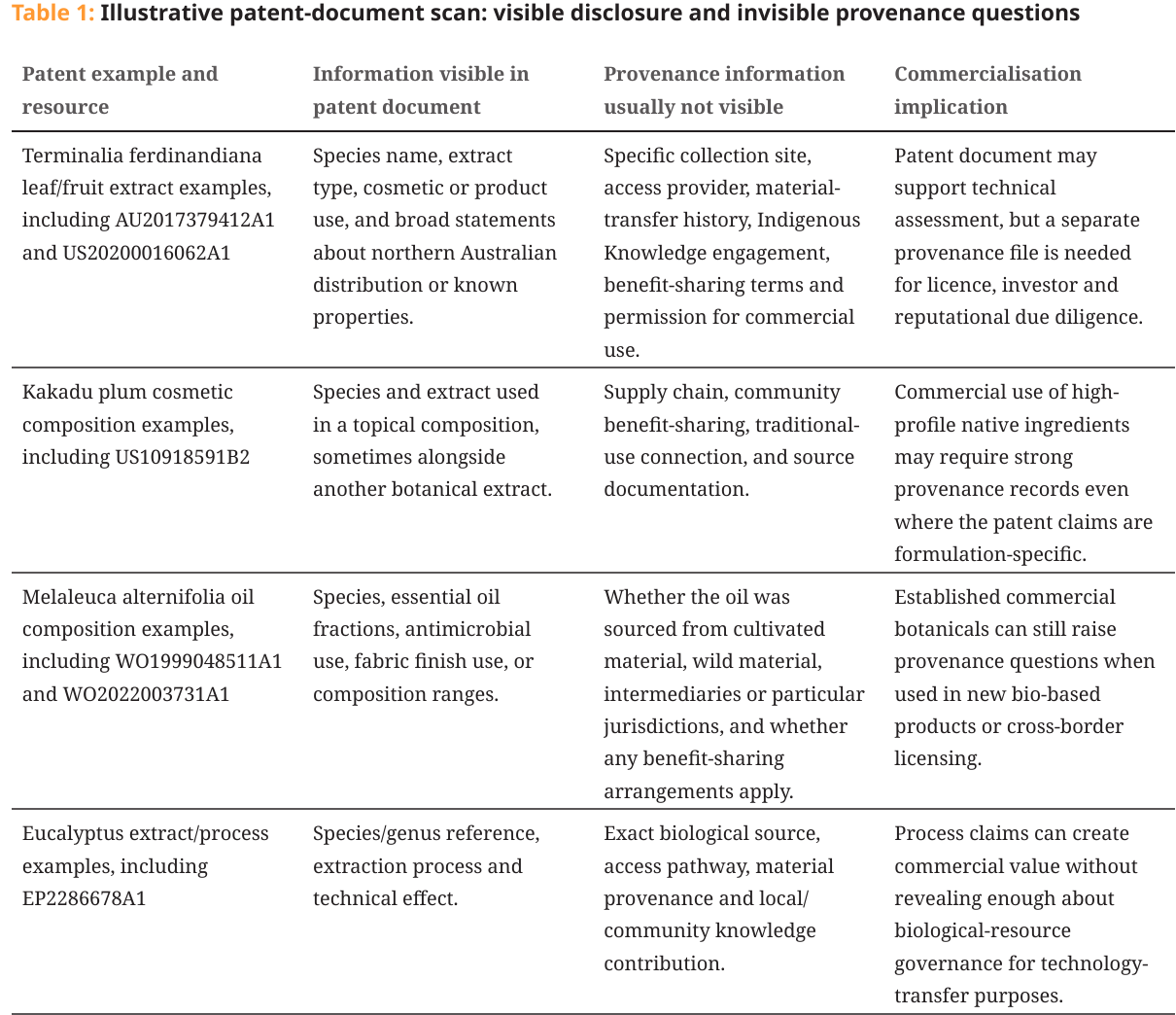
Table 1 summarises the kinds of information commonly visible in selected bio-based patent documents and the provenance questions that typically remain invisible. The table is illustrative rather than exhaustive. It is intended to show why patent analytics should be used as an entry point for commercialisation due diligence, not as a substitute for it.
6. Commercialisation implications for technology-transfer actors
The immediate implication is that technology-transfer offices should treat provenance information as part of the invention intake process. Many invention disclosure forms ask whether third-party IP,
research tools, grants, students, collaborators or publications are involved. For bioeconomy inventions, comparable questions should be asked about biological materials, collection permits, access providers, intermediaries, Indigenous Knowledge, traditional-use information, sequence data and intended commercial fields. This should not be reduced to a compliance checkbox. It should be used to build an evidence pack that can travel with the technology from laboratory to patent filing, option agreement, licence, start-up formation or investor review.
Material transfer agreements are particularly important. A biological material may move several times before it becomes part of an invention. It may pass from a landholder to a researcher, from a herbarium or culture collection to a laboratory, from one university to another, or from a public research organisation to a start-up. Each transfer may carry restrictions on use, publication, onward transfer, commercialisation or benefit-sharing. The Nagoya Protocol Best Practice Guidelines of the ARC Centre of Excellence in Synthetic Biology (CoESB) recognise this problem in practical terms. They state that when researchers receive genetic resources from intermediaries such as herbaria, traders, nurseries or culture collections, they should inquire whether the resources are ABS compliant, and if the intended use goes beyond an existing agreement, a new benefit-sharing agreement covering commercial uses should be negotiated (ARC Centre of Excellence in Synthetic Biology, 2026).
Investors and licensees also need a clearer provenance position. In many technology deals, patent title and freedom to operate receive detailed attention, but access and benefit-sharing obligations are treated late or not at all. This can create hidden liabilities. A licensee may discover that the licensor cannot provide evidence of lawful access, that commercial use was not covered by the original collection permission, or that the patent filing will trigger disclosure questions that the research team cannot answer confidently. Even where legal risk is manageable, reputational risk may be material, especially for consumer-facing products involving native plants, cosmetics, foods, nutraceuticals or wellness claims. Provenance readiness therefore strengthens bargaining credibility. It gives investors and licensees a basis to allocate risk rather than abandon the transaction.
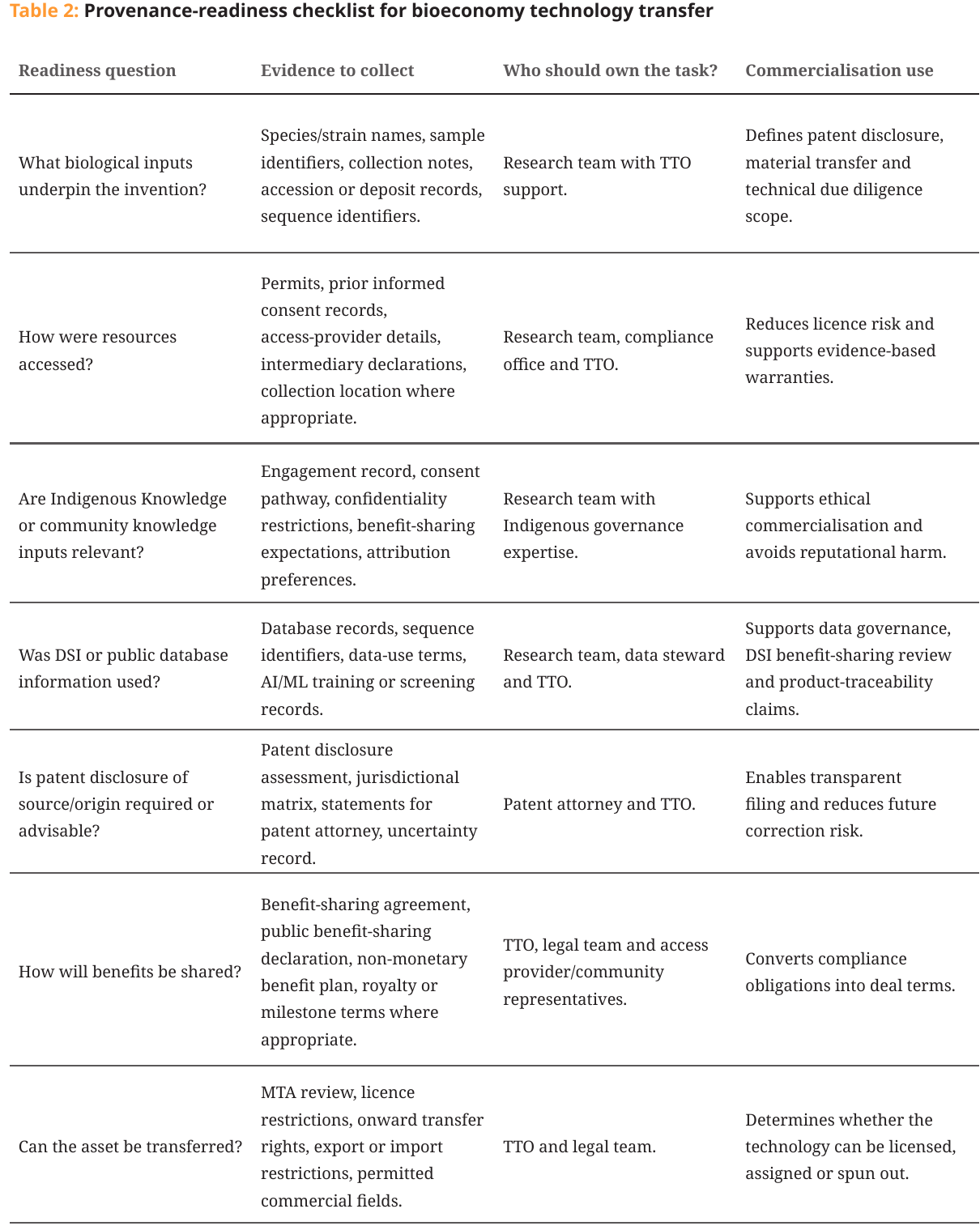
Start-ups and MSMEs face the most acute burden. They are often encouraged to use biodiversity, waste streams, microbial platforms and local biological resources to create sustainable products, but they may lack access to patent analytics, ABS advice and template agreements. For them, provenance readiness should be simplified into practical tools: a source record, a material-transfer record, a permissions map, a data-use map, a patent disclosure assessment and a benefit-sharing risk note. These tools do not remove the need for legal advice. They reduce the likelihood that commercialisation stalls because foundational information was never collected.
For Indigenous Peoples and local communities, provenance readiness can support recognition, consent, benefit-sharing and control over the use of knowledge and resources. However, it must be implemented carefully. Documentation systems should not extract or expose sensitive knowledge without community authority. The WIPO Treaty itself contemplates information systems for genetic resources and associated traditional knowledge in consultation with Indigenous Peoples, local communities and other stakeholders (WIPO, 2024a). The practical lesson is that better information can support patent examination and commercialisation, but only if information governance respects cultural authority, confidentiality, data sovereignty and local benefit.
7. A provenance-readiness framework for the Asia-Pacific bioeconomy
The framework proposed here has five stages. The first is input identification. The research team should identify each biological input, including plant material, microbial resource, tissue, germplasm, extract, compound, environmental sample, database sequence, AI-generated biological design or associated knowledge claim. Vague descriptions such as ‘plant extract’ or ‘microbial sample’ may be insufficient for later patent disclosure, material transfer or benefit-sharing questions. Where scientific uncertainty exists, the uncertainty should be recorded.
The second stage is access and source verification. The relevant question is not merely who supplied the material to the laboratory, but who had authority to permit access and use. This is particularly important where materials arrive through intermediaries. The CoESB guidelines define intermediaries to include nurseries, museums, arboretums, seed traders, herbaria or microbiome culture collections (ARC Centre of Excellence in Synthetic Biology, 2026). In commercialisation terms, an intermediary can be a weak link in the chain if the original collection circumstances are unclear.
The third stage is knowledge and data mapping. Bioeconomy innovations increasingly combine physical material with information. DSI may allow product development without repeated physical access to genetic resources. AI and machine learning can also identify patterns, predict functions, design biological pathways or screen biological candidates. The provenance file should therefore map not only tangible material, but sequence data, databases, metadata, associated publications, traditional-use references and community-held knowledge inputs. Where knowledge is culturally sensitive or confidential, the record should indicate governance conditions rather than disclose restricted content.
The fourth stage is IP and patent disclosure assessment. Before filing, the institution should ask whether the claimed invention is based on genetic resources or associated traditional knowledge in a way that may trigger disclosure obligations under current or emerging law. In Australia, this issue is live because IP Australia is considering disclosure-of-source options for patents and potentially plant breeder’s rights (IP Australia, 2026). For cross-border patent strategies, the assessment should also consider disclosure requirements in other jurisdictions. Even before formal rules apply, voluntary clarity may support commercial credibility where the provenance information is available and appropriate to disclose.
The fifth stage is deal integration. Provenance information should be reflected in licences, collaboration agreements, MTAs, start-up assignments, investment due diligence and benefit-sharing arrangements. A licence that grants commercial rights without addressing material-transfer restrictions or benefit-sharing obligations may create uncertainty. A start-up licence should specify whether the company receives patents only, or also biological materials, strains, samples, know-how, data, regulatory materials and the right to continue negotiations with access providers. Investor due diligence should include a provenance schedule in the data room, not only a patent schedule.
8. Policy lessons for Asia-Pacific regional cooperation
The policy implications extend beyond Australia. Asia-Pacific economies differ widely in biodiversity, industrial capability, patent-office resources, ABS implementation, Indigenous and local-community governance, and bioeconomy finance. A single regional model would be unrealistic. However, ESCAP and member States can support common infrastructure that helps innovators move from research to responsible markets.
First, the region should develop provenance-ready technology-transfer templates. These could include model invention disclosure questions for bioeconomy inventions, standard material-transfer clauses, benefit-sharing issue checklists, patent disclosure prompt sheets and licence schedules for genetic resources and associated knowledge. Templates should be adaptable to national law and community protocols. Their value would not lie in legal uniformity, but in making the right questions routine.
Secondly, regional capacity-building should include patent and provenance analytics. Patent databases are valuable technology-information sources, but users need to understand their limits. Training should teach TTOs, start-ups and MSMEs how to read patent documents for species, source, accession numbers, deposits, assignee patterns, claim scope and missing provenance information. The goal is to build enough capability to identify risks early and seek specialist support where needed.
Thirdly, patent offices and innovation agencies should coordinate with biodiversity and Indigenous Knowledge authorities. Disclosure-of-source rules will be implemented through patent systems, but the information they depend on often sits in environmental law, community governance, research ethics, databases, permits and material-transfer documents. Without coordination, disclosure may become a formal statement disconnected from benefit-sharing practice. With coordination, disclosure can become a gateway to better technology-transfer documentation.
Fourthly, ESCAP could support regional peer learning between biodiversity-rich and technology-intensive economies. Australia, India, ASEAN economies, Pacific Island States, Japan, Singapore and the Republic of Korea bring different strengths. Some have advanced biotech manufacturing capability, some have rich biodiversity and community knowledge systems, some have strong patent-office infrastructure, and some have high MSME relevance in agricultural and natural-product sectors. A regional provenance-readiness agenda would help these systems interact more fairly.
Fifthly, blended finance and innovation programmes should require appropriate provenance documentation early. Funding programmes that support bio-based start-ups, circular bioeconomy pilots, biodiversity-based products or synthetic biology applications should not wait until market entry to ask provenance questions. A staged approach would be more practical: light-touch screening at grant application, detailed provenance planning at proof-of-concept, contractual review before pilot transfer, and full due diligence before commercial licensing or investment. This is consistent with wider climate technology transfer literature, which cautions that IP debates can obscure the importance of finance, local adaptation, co-development and institutional capacity (Jee et al., 2024).
9. Inclusion and community dimensions
Provenance readiness has an inclusion dimension because benefit-sharing may include employment, training, scholarships, co-authorship, attribution, research participation, community-controlled data governance and support for local enterprises. The CBD has stated that 50 per cent of Cali Fund resources will be allocated to the self-identified needs of Indigenous Peoples and local communities, including women and youth (CBD, 2025b). This provides a useful signal for bioeconomy commercialisation: inclusive benefit-sharing should be considered at the design stage, not treated as a reputational add-on.
For Australia and the wider region, the relevant policy question is how to avoid reproducing extractive models of innovation. A provenance-ready system should ask who contributes knowledge, who controls access, who bears environmental and cultural risk, and who participates in value creation. For community-based enterprises and MSMEs, the framework should be enabling rather than burdensome. The objective is to make responsible commercialisation easier by clarifying expectations, not to make bioeconomy innovation administratively impossible.
10. Conclusion
The Asia-Pacific bioeconomy will not be built by patents alone. Nor will it be built by biodiversity access rules alone. It will require practical systems that convert biological resources, data, knowledge and research outputs into assets that can be trusted, licensed, financed and transferred. Provenance readiness is the missing layer in that process.
Australia’s current policy setting illustrates the opportunity. The country has biodiversity resources, public research capability, commercialisation institutions and live reform discussions on disclosure of source for genetic resources and Traditional Knowledge. It also faces the practical complexity of fragmented access laws, Indigenous Knowledge governance, DSI developments and cross-border technology transfer. These features make Australia a useful case study for the Asian and Pacific Centre for Transfer of Technology (APCTT) and its regional audience.
The key recommendation reflecting this discussion is that provenance should be built into technologytransfer workflows before patent filing, licensing or investment due diligence. Specifically, invention disclosures should ask provenance questions and patent strategies should consider source/origin disclosure. At the commercialisation level, MTAs should preserve access and benefit-sharing terms, start-up licences should transfer the provenance documentation needed to use biological materials responsibly, and investors should ask for provenance files alongside the appropriate patent schedules and IP strategy. From the policy support perspective, it would be helpful if policymakers provide templates, training and regional cooperation mechanisms.
If Asia-Pacific economies are to use bio-based innovation to address climate change, biodiversity loss, resource depletion and inequality, they need commercialisation systems that are technically credible and socially legitimate. Provenance readiness can help provide that bridge. It turns biological origin, access, Indigenous Knowledge, data governance and benefit-sharing from late-stage risks into early-stage technology-transfer infrastructure. That is the practical step needed to move from native bio-resources to responsible bioeconomy markets.
Acknowledgements and Declarations
Authors acknowledge the use of Large Language Model (LLM) tools to help refine the grammar and language of some parts of this article. The resulting output was reviewed, verified, revised, and integrated into the final text, for which we take full responsibility.
References
1. ARC Centre of Excellence in Synthetic Biology. (2026). Nagoya Protocol best practice guidelines. https://www.coesb.com.au/research/nagoya-protocol-best-practice-guidelines/
2. Blom, C., Jaspars, M., Muminovic Rilak, J., & Hartman Scholz, A. (2025). From frameworks to finance: How sharing benefits from the use of digital sequence information can evolve to contribute to biodiversity conservation. Nature Biotechnology, 43, 1599–1602. https://doi.org/10.1038/s41587-025-02820-8
3. Convention on Biological Diversity. (2010). Nagoya Protocol on access to genetic resources and the fair and equitable sharing of benefits arising from their utilisation. https://www.cbd.int/abs/
4. Convention on Biological Diversity. (2025a). Digital sequence information on genetic resources. https://www.cbd.int/dsi-gr
5. Convention on Biological Diversity. (2025b, February 24). The Cali Fund launches in the margins of the resumed session of COP16. https://www.cbd.int/article/cali-fund-launch-2025
6. Department of Climate Change, Energy, the Environment and Water. (2026a). The Nagoya Protocol— Convention on Biological Diversity. https://www.dcceew.gov.au/science-research/australias-biologicalresources/nagoya-protocol-convention-biological
7. Department of Climate Change, Energy, the Environment and Water. (2026b). Permits for commercial or potentially commercial purposes. https://www.dcceew.gov.au/science-research/australias-biologicalresources/permits-commercial-or-potentially-commercial-purposes
8. Department of Climate Change, Energy, the Environment and Water. (2026c). Australia’s biological resources. https://www.dcceew.gov.au/science-research/australias-biological-resources
9. DSI Scientific Network. (2025). Navigating COP16’s digital sequence information outcomes: What researchers need to do in practice. Patterns, 6(3), Article 101208. https://doi.org/10.1016/j. patter.2025.101208
10. Economic and Social Commission for Asia and the Pacific. (2026). Resolution 82/2: Supporting the transition towards a sustainable bioeconomy in countries in Asia and the Pacific (E/ESCAP/RES/82/2).
11. IP Australia. (2022). Enhance and enable Indigenous Knowledge: Consultation report 2021. https:// www.ipaustralia.gov.au/tools-and-research/professional-resources/data-research-and-reports/ publications-and-reports/Enhance-and-enable-IK-consultation-report
12. IP Australia. (2025). Next steps taken in historic Treaty to protect Indigenous Knowledge. https://www. ipaustralia.gov.au/news-and-community/news/next-steps-taken-in-historic-treaty-to-protectindigenous-knowledge
13. IP Australia. (2026). Disclosure of source requirement for genetic resources and Traditional Knowledge in patent applications. https://www.ipaustralia.gov.au/about-us/public-consultations/intellectualproperty-policy/policy-register/disclosure-of-source-requirement-for-genetic-resources-andtraditional-knowledge-in-patent-applic
14. Jee, S. J., Hotte, K., Ring, C., & Burrell, R. (2024). Making intellectual property rights work for climate technology transfer and innovation in developing countries. arXiv. https://arxiv.org/abs/2408.12338
15. Lawson, C., Englezos, E., & Rourke, M. (2025). Access and benefit sharing biological materials for machines: Artificial intelligence, machine learning and deep learning. Plants, People, Planet, 7, 1485–1497.
16. Oguamanam, C. (2025). The WIPO Treaty on genetic resources and associated traditional knowledge: A negotiating, contextual and conceptual appraisal. Boston University International Law Journal, 43(2).
17. Okediji, R. (2025). Making room at the table: Theoretical foundations and practical implications of the WIPO Treaty on Intellectual Property, Genetic Resources and Associated Traditional Knowledge. Harvard International Law Journal, 66, 1.
18. Perron-Welch, F. (2026). Patents, genetic resources, and traditional knowledge: The WIPO treaty and the global access and benefit-sharing regime complex. Journal of Law and the Biosciences, 13(1), Article lsag015. https://doi.org/10.1093/jlb/lsag015
19. World Intellectual Property Organization. (2024a). Summary of the WIPO Treaty on Intellectual Property, Genetic Resources and Associated Traditional Knowledge. https://www.wipo.int/en/web/treaties/ip/ gratk/summary_gratk
20. World Intellectual Property Organization. (2024b, May 24). WIPO Member States adopt historic new Treaty on Intellectual Property, Genetic Resources and Associated Traditional Knowledge. https://www. wipo.int/en/web/igc/w/news/2024/wipo-member-states-adopt-historic-new-treaty-on-intellectualproperty-genetic-resources-and-associated-traditional-knowledge
21. Yu, P. K. (2024). WIPO negotiations on intellectual property, genetic resources and associated traditional knowledge. Akron Law Review, 57(2).
Patent documents
1. Cock, I. E., Boehme, D. J., & Miles, R. A. (2019). Terminalia ferdinandiana leaf extract and products containing extract of Terminalia ferdinandiana leaf (Patent No. AU2017379412A1). IP Australia. https://patents.google.com/patent/AU2017379412A1/en
2. Maeda, Y., Narise, A., Kikuchi, S., & Osawa, K. (2011). Process for preparing a eucalyptus extract (Patent No. EP2286678A1). European Patent Office. https://patents.google.com/patent/EP2286678A1/ en
3. Aravena, J., Hines, M., Jones, B., & Gan, D. (2021). Compositions comprising Kakadu plum extract or acai berry extract (Patent No. US10918591B2). U.S. Patent and Trademark Office. https://patents. google.com/patent/US10918591B2/en
4. Cock, I. E., Boehme, D. J., & Miles, R. A. (2020). Terminalia ferdinandiana leaf extract and products containing extract of Terminalia ferdinandiana leaf (Patent No. US20200016062A1). U.S. Patent and Trademark Office. https://patents.google.com/patent/US20200016062A1/en
5. Andriolli, A., & Panni, F. (1999). Antifungal and antibacterial compositions containing Melaleuca essential oil (Patent No. WO1999048511A1). World Intellectual Property Organization. https://patents. google.com/patent/WO1999048511A1/en
6. Devaraj, V. K. (2022). Melaleuca alternifolia plant-based antimicrobial finish on fabrics and method thereof (Patent No. WO2022003731A1). World Intellectual Property Organization. https://patents. google.com/patent/WO2022003731A1/en
Technology offer
Interested in this technology?
Request further information or explore potential cooperation with the technology provider.
Technology request
Can you help meet this technology need?
Share a relevant technology, expertise or partnership opportunity with APCTT.