

From Biological Carbon Capture to Circular Bioeconomy: Smart Microalgal Technologies for Sustainable Industrial Transformation in the Asia-Pacific
The Asia-Pacific region hosts one of the world’s largest concentrations of coal-fired power plants, cement kilns, and steel plants, which together drive the majority of global industrial CO₂ emissions. Under the Paris Agreement’s 1.5°C goal, India has committed to Net Zero by 2070, with NITI Aayog’s 2026 Scenarios Towards Viksit Bharat and Net Zero roadmap identifying carbon capture, utilisation, and sequestration (CCUS) as a critical enabler. The region’s position as a leading commercial microalgae hub makes it well-placed to advance this transition. This article examines how microalgal cultivation—strengthened by sensor-based monitoring, artificial intelligence, and strain improvement—offers a scalable platform for biological CO₂ valorisation and bioproduct generation. It reviews smart photobioreactor systems, adaptive strain engineering, and integrated biorefinery design, drawing on pilot projects from India, China, Japan, and Malaysia. The article outlines policy, financing, and cooperation measures needed to move algae-based carbon utilisation from pilot scale to industrial deployment, positioning Asia- Pacific to lead this circular bioeconomy frontier.
1. Introduction
The development narrative of Asia-Pacific and its climate responsibilities are coming together at the same set of smokestacks. The majority of the world’s approximately 9,000 coal-fired power plants are located in this region, and in contrast to the ageing fleets of North America and Europe, the coal and heavy-industry assets in developing economies are typically under 15 years old, compared to more than 40 years in other regions (IEA, 2022). That youth is a double-edged fact: it means these plants and kilns have decades of operating life ahead of them, but it also means the region has a correspondingly long window in which to retrofit them with carbon-utilisation pathways rather than waiting for natural retirement.
India’s own long-term planning exercise illustrates the scale of the challenge. The eleven volumes of research by NITI Aayog, Scenarios Towards Viksit Bharat and Net Zero, published till 2026, project that India can achieve a more than eight-fold growth of its economy, from USD 4.18 trillion to USD 30 trillion, and simultaneously reach net-zero GHG emissions by 2070 (NITI Aayog, 2026a). One volume of the research is devoted to industry sectors, and it admits that under the trajectory of current policy, fossil fuels would still provide 52% of energy used in industry by 2070, compared to 83% in 2025, and CCUS is listed among long-duration energy storage and small modular reactors as “nascent and unproven at scale” (NITI Aayog, 2026a). B. V. R. Subrahmanyam, the CEO of NITI Aayog, was reported to have noted at the report’s launch that fossil fuels would still account for about 25% of industrial energy use even in 2070, a residual load that would need to be managed through carbon capture and related technologies (News On AIR, 2026). Two concrete initiatives are already underway, according to the same industry volume: the introduction of five industrial CCUS test beds in the cement industry in 2025 and the use of low-clinker cement blends like Limestone Calcined Clay Cement, which can reduce CO₂ emissions from the cement process by up to 40% (NITI Aayog, 2026a).
Most of the CCUS conversation in India and across the region still centres on geological storage and chemical absorption. Microalgae-based biological carbon capture is a complementary and, in some ways, more instantly deployable method. Microalgae may be fed directly with flue gas without first being purified, and fix CO₂ photosynthetically at rates claimed to be 10–50 times higher per unit area than terrestrial plants, and transform nitrogen and sulphur oxides that would normally need to be scrubbed into usable nutrients (Zhang, 2015). Importantly, Asia-Pacific does not need to build this capability from scratch. The region already hosts the world’s largest commercial microalgae market, accounting for an estimated 42.3% of global revenue in 2025, underpinned by decades of commercial Spirulina and Chlorella cultivation in China, Japan, Taiwan, and India (Dataintelo, 2026). This article explores how the current cultivation base can be expanded from nutraceutical production to industrialscale carbon utilisation using smart photobioreactor monitoring, artificial intelligence, and adaptive strain engineering. It also discusses what financial and policy changes would be required to make that transition bankable.
2. The Case for Biological Carbon Capture
The appeal of microalgae for use in CO₂ utilisation is based on four key advantages. To start with, flue gas requires no complex pre-treatment prior to being fed to the culture of microalgae. Research has shown that the species of Chlorella can survive up to 100% CO₂ content; however, optimal growth is attained at 10% CO₂ content, which corresponds to industrial flue gases (Zhang, 2015). Secondly, nitrogen and sulphur oxides contained in the flue gas, which would normally necessitate the installation of separate scrubbing units, can act as nutrients to promote microalgal cultivation, thus making the whole process of flue gas handling simpler (Zhang, 2015). Thirdly, in contrast with the geological sequestration, where the captured carbon does not generate any additional profit but is simply stored, microalgal cultivation creates a product in the form of biomass from which lipids, proteins, pigments, and other valuable substances are produced to provide an economic incentive to balance part of the cost of the process (Dutta et al., 2025).
Fourthly, the technology promotes a circular bioeconomy, whereby after the extraction of high-value materials, the leftover biomass is anaerobically digested to create biogas. Moreover, there are numerous microalgae species capable of growing in municipal, industrial, and agricultural wastewater to allow for the combined CO₂ capture, nutrient recovery, and wastewater treatment processes.
These benefits explain why, over the past 15 years, utilities, oil and gas firms, and speciality chemical producers around the region have shown consistent, if still sub-commercial, interest in microalgal CO₂ biofixation, as the case studies below show.
3. From Pilot to Practice: Asia-Pacific Case Studies
3.1 India
One of India’s earliest and most widely cited demonstrations of biological carbon capture was the pilot reactor established at ONGC’s Hazira facility in Surat, Gujarat, to capture CO₂ from vent gas using Chlorella sp. and a mixed consortium of Scenedesmus quadricauda, Chlorella vulgaris, and Chlorococcum humicola. Anaerobic digestion of the harvested biomass at Hazira produced methane yields of 386 L CH₄ kg⁻¹ VS when Chlorella was cultivated alone, against 228 L CH₄ kg⁻¹ VS for the mixed consortium — a gap the researchers attributed partly to the carbonation column’s performance upstream, which had brought vent-gas CO₂ down from an average of 34% to 15% by volume while sustaining Chlorella growth of 18 g m⁻² day⁻¹ (Yadav et al., 2016). Separately, Baral et al. (2015) reported pilot microalgal carbon capture initiatives at the Angul thermal power plant in Odisha and the Kolaghat Thermal Power Station in West Bengal. The review noted that the 1,260 MW Kolaghat plant had an estimated CO₂ footprint of approximately 15,000 t day⁻¹, with plans to redirect about 50% of these emissions to microalgal cultivation. The residual oil cake remaining after lipid extraction was also proposed as a supplementary fuel for the power plant (Baral et al., 2015). An integrated study involving GAIL India utilised 90–99% CO₂ from natural gas processing together with 13–15% CO₂ from thermal power plant flue gas (Chandrapura and Santaldih Thermal Power Stations) for microalgal cultivation. The study screened freshwater algal strains for rapid growth, photosynthetic efficiency, tolerance to NOₓ and SOₓ, temperature resilience, and the production of value-added products (Anguselvi et al., 2019).
3.2 China
China’s CCUS programme is considerably larger in scale, with roughly 40 demonstration and pilot projects in operation or under construction as of the early 2020s, collectively capturing on the order of three million tonnes of CO₂ annually, though the bulk of this activity remains concentrated in enhanced oil recovery in the petroleum, coal-chemical, and thermal-power sectors rather than in full-chain, largescale industrialisation (Liu et al., 2022). Bibliometric analysis of the field confirms that China leads global CCUS research output, with the Chinese Academy of Sciences among the most prolific institutional contributors (Liu et al., 2022), and the same review estimates that CCUS-driven emission reductions of 0.6–1.4 billion tonnes by 2050 and 1–1.8 billion tonnes by 2060 will be needed to meet the country’s carbon-neutrality pathway. Within this landscape, microalgae-based biofixation appears specifically as one of the utilisation routes tracked alongside enhanced oil recovery, saline-aquifer storage, and mineral carbonation (Liu et al., 2022). At the project level, journalistic reporting from the early 2010s documented the energy company ENN Group operating a greenhouse-style facility in which CO₂ piped from a nearby coal-fired power plant was fed through banks of tubes to cultivate oil-rich microalgae destined for biodiesel production, while China Huaneng Group had equipped coal plants in Beijing and Shanghai with capture systems selling the recovered CO₂ to beverage manufacturers. Shenhua’s coal-to-liquids complex at Erdos in Inner Mongolia was operating a geological storage pilot, with reports indicating that only around 5% of the plant’s annual CO₂ emissions were being sequestered because of cost constraints (Liu, 2012). As these reports date back to the early 2010s, the current operational status of these facilities could not be independently verified for this review. Nevertheless, they illustrate China’s early exploration of both geological and biological CO₂ utilisation pathways and highlight the economic considerations that continue to drive interest in lower-capex biological approaches. More recently, Chinese state media reported that Shanxi Agricultural University had developed a microalgae-based flue-gas treatment system reported as being approximately 10 times more effective at removing carbon than equivalent terrestrial vegetation, absorbing more than 65% of the CO₂ from treated waste gas (International Centre for Sustainable Carbon, 2019, citing Xinhua).
3.3 Japan
Japan has been an early and consistent adopter of microalgal CO₂ utilisation technologies, particularly those based on Euglena, a photosynthetic microalga capable of tolerating elevated CO₂ concentrations representative of industrial flue gases (Xin et al., 2023; Erfianti et al., 2025). According to Japan for Sustainability (2009), a 2009 field trial conducted jointly by Euglena Co. and Okinawa Electric Power Company injected exhaust gas from the utility’s Kin Thermal Power Station into cultivation tanks and found it increased Euglena growth by up to 20 times relative to air-fed controls; the resulting acidification also helped suppress contaminating organisms. According to Euglena Co. (2016), the company subsequently partnered with Chubu Plant Service and local authorities in Mie Prefecture, with support from a Ministry of Economy, Trade and Industry subsidy, to construct what it described as Japan’s largest fuel-microalgae culture pond, co-located with a woody-biomass power plant and using its exhaust gas, wastewater, and waste heat as combined inputs for cultivation. On the industrial-fuels side, IHI Corporation, working under a programme funded by the New Energy and Industrial Technology Development Organization (NEDO) since 2017, has developed integrated cultivation-to-fuel technology around a fast-growing, oil-rich microalga (Botryococcus braunii), operating pilot outdoor cultivation facilities in both Kagoshima, Japan, and Saraburi Province, Thailand. The resulting bio-jet fuel met the ASTM D7566 Annex 7 international standard for sustainable aviation fuel in May 2020, and on 17 June 2021 was blended into the fuel used for a pair of one-off demonstration flights departing Tokyo’s Haneda Airport — a Japan Airlines service to Sapporo and an All Nippon Airways service to Osaka — rather than into an ongoing commercial supply chain (NEDO, 2021). The Japan–Thailand collaboration provides a useful model for the cross-border technology-transfer partnerships needed to accelerate the regional bioeconomy transition.
3.4 Malaysia
Malaysia’s pilot-scale work is shaped by its position as the world’s second-largest palm oil producer (Malaysian Palm Oil Board, 2024) and the correspondingly large volumes of palm oil mill effluent (POME) generated by its palm oil industry. Because POME is nutrient-rich but also a major water pollutant if discharged untreated, it has been studied extensively as a low-cost growth medium for Chlorella sp.;
one peer-reviewed study identified an optimal combination of roughly 10.9% CO₂ concentration and approximately 9,964 lux of light intensity for maximising simultaneous CO₂ sequestration and biodieselrelevant lipid accumulation (Bhuyar et al., 2021). An integrated system combining CO₂-rich flue gas from palm oil mill boilers with POME could, in principle, utilise two industrial waste streams simultaneously. However, this review did not identify published studies directly evaluating such an integrated approach and therefore presents it as a potential design concept rather than a demonstrated process. This agroindustrial pairing represents a distinctively Southeast Asian variant of the biological CCU model that does not depend on power-sector infrastructure.
3.5 Synthesis
Read together, these four national experiences show a consistent pattern: the underlying biology is well understood and has been demonstrated at pilot scale for more than a decade, but almost none of these projects has crossed from pilot into a commercially self-sustaining, industrial-scale operation. The recurring bottlenecks are less about whether microalgae can tolerate flue gas — they have consistently been shown to do so in pilot-scale studies — and more about the economics and operational reliability of scaling cultivation, harvesting, and downstream processing to match the gigatonne-scale carbon streams that power plants, cement kilns, and steel mills actually produce. Addressing that gap is where smart cultivation technologies and improved strains become decisive.
4. Smart Photobioreactor Systems: Sensors, IoT and Artificial Intelligence
Historically, one of the major obstacles to scaling microalgal cultivation has been the cost and limited speed of process monitoring: photobioreactors (PBRs) require continuous tracking of temperature, pH, light intensity, dissolved gases, and biomass density, and manual sampling methods are both labourintensive and too slow to support real-time process control (Imamoglu, 2024). Artificial intelligence and machine learning are increasingly closing this gap. A recent review catalogues applications of support vector machines, genetic algorithms, decision trees, random forests, artificial neural networks, and deep learning across the full microalgae production chain — from real-time growth monitoring and species identification through to optimisation of cultivation conditions, harvest timing, and downstream purification of bioproducts (Imamoglu, 2024). The same review highlights the potential of machinelearning approaches to optimise harvest timing and improve process efficiency in microalgal cultivation systems (Imamoglu, 2024).
Concrete implementations illustrate what this looks like in practice. One tubular photobioreactor system for Chlorella sp. cultivation integrates seven types of sensors—temperature, pH, light intensity, electrical conductivity, flow rate, dissolved oxygen, and light-exposure duration—managed through an ESP8266 microcontroller, with an attached camera capturing images every 30 minutes to track growth non-invasively, all combined with computational fluid dynamics modelling of the reactor’s internal flow (Tummawai et al., 2024). At the commercial scale, a machine-learning decision-support framework developed for tubular photobioreactors cultivating Nannochloropsis sp. integrated three years of farm operational logs, meteorological data, and digital-imaging cell-concentration measurements to predict next-day post-harvest cell density, allowing operators to make harvest-fraction decisions on a datadriven rather than heuristic basis; in a twelve-reactor commercial field trial, this approach matched conventional yields with lower variability (Kadosh et al., 2026). A related real-time imaging system for Scenedesmus dimorphus monitoring combined RGB colour-histogram image analysis with decision-tree and random-forest models; the authors discuss how such an approach could be extended through multisensor data fusion, automated feedback control, and Internet-of-Things connectivity for continuous, industrial-scale decision-making (Uguz et al., 2025).
For the Asia-Pacific pilot projects described above, these technologies could provide one of the key enablers for scaling microalgal CO₂ utilisation beyond demonstration projects. Sensor-and AI-enabled process control can improve operational stability while reducing the expertise and labour required to manage large photobioreactor arrays. Such advances are likely to help bridge the gap between pilot-scale demonstrations and commercial deployment, allowing biological carbon utilisation systems to operate more reliably at scales relevant to industrial CO₂ emissions.
5. Adaptive Strain Engineering: Building CO₂-Tolerant, High-Value Algae
Sensors and control systems can only optimise what a given strain is biologically capable of. Many wildtype microalgae experience growth inhibition at CO₂ concentrations above about 5%, while some strains can grow at the higher concentrations typically found in flue gas (10–15%), although carbon fixation and biomass production may decline (Zhang, 2015). In contrast to genetic engineering, Adaptive Laboratory Evolution (ALE) selects for beneficial spontaneous mutations by subjecting cultures to gradual, step-wise increases in an environmental stressor—typically CO₂ concentration, but also temperature, salinity, or copollutant load—without introducing foreign genetic material. This has made ALE a particularly appealing approach for this purpose (He et al., 2025). Recent work on adaptively evolved Nannochloropsis oceanica demonstrates how strain improvement can alter stress-related and biochemical characteristics, including selenium-associated functional properties (Reshma and Arumugam, 2022; Pawar and Arumugam, 2026). This matters practically as well as scientifically: because ALE does not require the deliberate introduction of foreign genetic material, it may offer regulatory and public-acceptance advantages over genetically modified microalgae, particularly for open-pond or environmental applications.
A recent review of microalgae-driven CCUS strain engineering documents the results such programmes have achieved: sequential exposure of Chlorella sp. to 10% and then 20% CO₂ across dozens of adaptation cycles produced evolved lines capable of sustained growth at CO₂ concentrations up to 30%, alongside significantly elevated chlorophyll content relative to the unadapted parent strain (Li et al., 2015; He et al., 2025). The same review reports that ALE protocols incorporating the toxic co-pollutants found in real flue gas — including nitrogen and sulphur oxides — have been used successfully to adapt Chlorella sp. to gas mixtures approximating actual industrial exhaust, through gradual stepwise increases in pollutant concentration sustained over several months (Cheng et al., 2019; He et al., 2025). Temperature tolerance is a parallel and, for Asia-Pacific’s outdoor open-pond systems, equally important target: ALE work on the diatom Nitzschia inconspicua has specifically targeted improved thermal tolerance at temperatures above 37°C, a condition highly relevant to raceway-pond cultivation under South and Southeast Asian ambient conditions (LaPanse et al., 2022).
Strain-improvement efforts need not target CO₂ or temperature tolerance alone. The same stress-based ALE logic has been used to co-select for high-value product traits — for instance, combining elevated CO₂ exposure with adaptation cycles that simultaneously increase carotenoid or pigment content — which is directly relevant to the biorefinery framing this article advocates, since it means a single strain-improvement programme can target flue-gas tolerance and commercial product value at once, rather than treating them as separate research tracks (Udayan et al., 2017). Genetic-engineering approaches using CRISPR-Cas systems, most developed in the model species Chlamydomonas reinhardtii, offer a complementary route with potentially larger single-step gains, though the technology still faces meaningful optimisation and regulatory hurdles before it is field-deployable at the scale ALE-derived strains already permit.
6. Circular Bioeconomy and Market Context
A defining feature of the Asia-Pacific opportunity is that it does not require building a new industry from the ground up. China’s dominance of the sector is stark: of the roughly 56,000 tonnes of microalgae biomass the FAO recorded worldwide in 2019, China alone supplied more than 97%—a concentration built on decades of established Spirulina and Chlorella farming across East and South Asia (Ashour and Omran, 2022). The same FAO-sourced figures caution that reported totals likely undercount production in countries where the industry is less centrally tracked, so the true regional base is probably larger than the figures suggest (Ashour and Omran, 2022). This existing cultivation base could provide a useful foundation for carbon-utilisation deployment: new CO₂-fed facilities would not necessarily need to develop basic cultivation and harvesting capabilities from scratch, but would instead need to adapt existing systems to flue-gas feedstocks and, where relevant, incorporate the sensor and strainimprovement approaches discussed above.
The economic framing of these projects matters as much as the underlying biology. Global patent activity in microalgal biofuels rose sharply through the early 2010s and subsequently declined, highlighting the vulnerability of business models centred on a single commodity product whose economics are
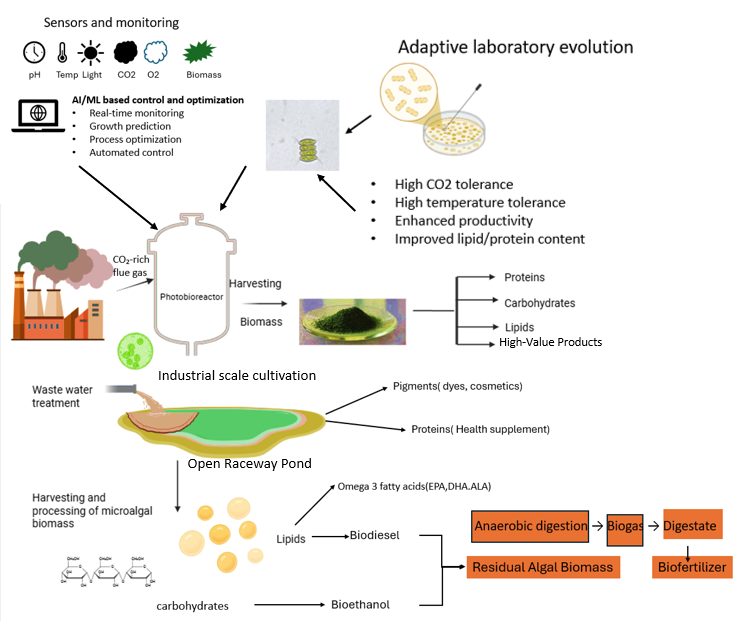
sensitive to energy-market conditions (Li et al., 2020). Techno-economic analysis across multiple algal biorefinery pathways bears this out: to reach economic viability, algal biofuel production must either incorporate higher-value non-fuel co-products or achieve drastic capital-cost reductions that have not yet materialised at scale (Cruce and Quinn, 2019). The more resilient model — one that several of the cases reviewed above point toward, from Hazira’s biogas co-product to Malaysia’s proposed integration of POME with CO₂-rich flue gas — pairs carbon capture with higher-value products: lipid and carotenoid products have been reported to command approximately eightfold and 135-fold higher prices, respectively, in food-additive markets than as biofuel feedstocks (Sun et al., 2018). A laboratory whose existing technical strength lies in nutraceutical extraction and characterisation is, in this sense, well positioned to contribute to CO₂-sequestration research: the same biomass-characterisation and productrecovery expertise that supports high-value extract development is directly transferable to evaluating the co-product economics of a carbon-capture strain, rather than being a separate line of work bolted onto it.
Closing the loop further, harvested biomass can be routed to anaerobic digestion for biogas, as demonstrated at Hazira, potentially recovering energy and reducing residual-waste disposal costs that would otherwise erode the economics of the facility (Yadav et al., 2016).
7. Policy, Financing and Cooperation Measures
Translating these technical building blocks into industrial deployment will require deliberate policy design across at least four areas.
First, demonstration-stage risk capital needs to be explicitly available for biological, and not only geological, CCU pathways. The NITI Aayog Scenarios Towards Viksit Bharat and Net Zero study identifies CCUS among technologies that remain at an early stage of deployment and require further development and demonstration in India (NITI Aayog, 2026a). The industry volume similarly indicates that a substantial share of India’s future industrial emissions reductions will depend on technologies that are not yet available at commercial scale and remain at the pilot or demonstration stage (NITI Aayog, 2026a). Given the scale of investment required across the wider net-zero transition, dedicated support for emerging biological CCU pathways could help diversify India’s portfolio of industrial decarbonisation technologies. Explicitly including microalgae-based utilisation in demonstration and support programmes
alongside chemical and geological CCUS pathways could provide a route for biological CCU technologies to progress beyond the pilot stage. Biological CCU approaches also remain at varying stages of technological maturity; for example, the bio-integrated carbon capture and utilisation (BICCU) concept described by Sieborg et al. (2024) had reached only laboratory proof-of-concept development (TRL 2), highlighting the need for further demonstration before industrial deployment. Because microalgal biofixation can provide an alternative or complementary pathway to geological sequestration, it should be considered within demonstration-stage CCUS funding programmes alongside conventional capture and storage routes. Economic modelling has shown that integrating microalgal biofixation with geological sequestration can create synergies in CO₂ abatement and supply-chain design (Yue et al., 2015). This is not a marginal financing question: the same study projects India’s private-consumption share of GDP to decline from 58% in 2025 to 52% by 2070, while public spending and investment gain importance (NITI Aayog, 2026b).
Second, carbon-market design needs to catch up with biological utilisation specifically. China’s national emissions trading scheme has expanded beyond the power sector to cover steel, cement and aluminium smelting, with the expanded coverage applying from the 2024 compliance year, while the country is also developing policies aimed at controlling both total carbon emissions and carbon intensity (International Carbon Action Partnership, 2025). In principle, such market mechanisms could create a future revenue stream for verified microalgal CO₂ utilisation. However, monitoring, reporting and verification (MRV) frameworks for emerging carbon-removal pathways are still developing, with approaches being developed in a fragmented manner across stakeholders (Hoffmann et al., 2026). Establishing credible MRV methods for biological CO₂ utilisation will therefore be important for its meaningful participation in carbon markets and offset mechanisms.
Third, intellectual property and access-and-benefit-sharing frameworks need deliberate attention as the field commercialises. Patent activity in algae-related biotechnology has historically concentrated in the United States, Japan, and China (Li et al., 2020), and the Budapest Treaty provides an internationally recognised mechanism for depositing microorganisms for patent-procedure purposes (WIPO, 2026), but developing-country research institutions across the wider Asia-Pacific region need better practical access to these mechanisms if they are to protect strains they develop rather than depending entirely on licensed foreign technology. Because biodiverse marine and coastal environments represent important sources of microbial and algal resources for bioprospecting (Chen et al., 2024; Pattapulavar et al., 2026), research programmes should build Nagoya Protocol-consistent access-and-benefit-sharing procedures into straincollection work from the outset (Convention on Biological Diversity, 2011), both as a legal safeguard and as a matter of equitable practice with the communities and ecosystems from which strains are sourced.
Fourth, cross-border technology transfer within the region should be actively cultivated rather than left incidental. The Japan–Thailand collaboration between IHI Corporation and NEDO, which established integrated cultivation and SAF-production technology using fast-growing microalgae and operated a pilot outdoor cultivation facility in Saraburi, Thailand, provides a working example of bilateral technology demonstration; microalgae-derived SAF was subsequently supplied to regular commercial flights in Japan (NEDO, 2021; IHI, 2021). Similar partnerships could link India’s cement-sector CCUS test beds with Southeast Asian palm-oil-sector POME–CO₂ integration work, where the underlying biological and engineering challenges overlap substantially despite differing feedstocks. Regional bodies with an explicit technology-transfer mandate are well placed to broker exactly this kind of matchmaking between complementary pilot experiences.
Gender considerations are also relevant to how this transition is designed, not only how it is measured. Biorefinery pathways oriented toward nutraceutical, food, and feed applications could create downstream opportunities in quality control, formulation, and extension services. Deliberately designing skill-development programmes and small-scale enterprise models — for example, POME-fed or wastewater-fed algae units suited to cooperative or smallholder operation — could help broaden participation in the emerging circular bioeconomy and ensure that employment opportunities are distributed across the value chain rather than concentrated solely in capital-intensive industrial roles.
8. Conclusion
Asia-Pacific occupies a distinctive position in the global carbon-utilisation landscape: it hosts a major concentration of the industrial CO₂ sources that need to be addressed and a large existing base of commercial microalgae cultivation capacity that could help address them. The pilot projects reviewed here — from Hazira’s carbonation column to Euglena Co.’s exhaust-gas trials, from ENN Group’s coal-fed cultivation tubes to Malaysia’s POME-integrated systems — have demonstrated the technical feasibility of microalgal carbon utilisation across different industrial contexts. What has been missing is the combination of process technologies that make cultivation reliable and cost-effective at industrial scale: sensor-and AI-enabled photobioreactor control to close the monitoring gap; non-GM adaptive strain engineering to improve CO₂ and temperature tolerance and maintain productivity under industrial conditions; biorefinery economics anchored in diversified, high-value product portfolios rather than biofuel alone; and financing, carbon-market, and intellectual-property frameworks specifically calibrated to the bio-resource-dependent character of biological CCU. Bringing these elements together within the region’s existing cultivation infrastructure, rather than building parallel capacity from scratch, offers a practical pathway for Asia-Pacific to move from being a site of pilot demonstrations to a genuine architect of the circular bioeconomy transition its industrial emissions profile now demands.
References
1. Anguselvi, V., Masto, R.E., Mukherjee, A. and Singh, P.K. (2019). “CO₂ Capture for Industries by Algae”, in Algae, ed. Y.K. Wong (IntechOpen). DOI: 10.5772/intechopen.81800.
2. Ashour, M. and Omran, A.M.M. (2022). “Recent Advances in Marine Microalgae Production: Highlighting Human Health Products from Microalgae in View of the Coronavirus Pandemic (COVID-19)”, Fermentation, Vol. 8, No. 9, Article 466.
3. Baral, S.S., Singh, K. and Sharma, P. (2015). “The potential of sustainable algal biofuel production using CO₂ from thermal power plant in India”, Renewable and Sustainable Energy Reviews, Vol. 49, pp. 1061–1074. DOI: 10.1016/j.rser.2015.04.181.
4. Bhuyar, P., Sundararaju, S., Rahim, M.H.A. et al. (2021). “Microalgae cultivation using palm oil mill effluent as growth medium for lipid production with the effect of CO₂ supply and light intensity”, Biomass Conversion and Biorefinery, Vol. 11, pp. 1555–1563.
5. Chen, J., Jia, Y., Sun, Y., Liu, K., Zhou, C., Liu, C., Li, D., Liu, G., Zhang, C., Yang, T., Huang, L., Zhuang, Y., Wang, D., Xu, D., Zhong, Q., Guo, Y., Li, A., Seim, I., Jiang, L., Wang, L., Lee, S. M. Y., Liu, Y., Wang, D., Zhang, G., Liu, S., Wei, X., Yue, Z., Zheng, S., Shen, X., Wang, S., Qi, C., Chen, J., Ye, C., Zhao, F., Wang, J., Fan, J., Li, B., Sun, J., Jia, X., Xia, Z., Zhang, H., Liu, J., Zheng, Y., Liu, X., Wang, J., Yang, H., Kristiansen, K., Xu, X., Mock, T., Li, S., Zhang, W., & Fan, G. (2024). Global marine microbial diversity and its potential in bioprospecting. Nature, 633(8029), 371–379.
6. Cheng, Dujia, Xuyang Li, Yizhong Yuan, Chengyu Yang, Tao Tang, Quanyu Zhao and Yuhan Sun (2019). “Adaptive evolution and carbon dioxide fixation of Chlorella sp. in simulated flue gas”, Science of the Total Environment, Vol. 650, Part 2, pp. 2931–2938. DOI: 10.1016/j.scitotenv.2018.10.070.
7. Convention on Biological Diversity (CBD). (2011). Nagoya Protocol on Access to Genetic Resources and the Fair and Equitable Sharing of Benefits Arising from Their Utilization. Montreal: Secretariat of the Convention on Biological Diversity.
8. Cruce, J.R. and Quinn, J.C. (2019). “Economic viability of multiple algal biorefining pathways and the impact of public policies”, Applied Energy, Vol. 233–234, pp. 735–746.
9. Dataintelo (2026). “Microalgae Market Research Report 2034”, Dataintelo Market Research, April.
10. Dutta, S., Kataki, S., Banerjee, I., Pohrmen, C.B., Jaiswal, K.K. and Jaiswal, A.K. (2025). “Microalgal biorefineries in sustainable biofuel production and other high-value products”, New Biotechnology, Vol. 87, pp. 39–59.
11. Erfianti, T., B.R. Sadewo, N. Dewayanto, A.F. Yusuf, D. Kurnianto, D. Mardyansah, I.P. Wardani, B.S. Daryono, E.A. Suyono and A. Budiman (2025). “Enhanced CO₂ sequestration and paramylon production in acid-tolerant Euglena gracilis: Growth optimization and metabolic response under varying CO₂ concentrations”, Biotechnology Reports, Vol. 48, Article e00935.
12. Euglena Co., Ltd. (2016). “Euglena Co., Ltd. to Construct Japan’s Largest Microalgae Culture Pool for Fuel in Taki Town, Mie Prefecture”, Euglena Co. Press Release, 1 September.
13. He, Z., Wang, J. and Li, Y. (2025). “Recent advances in microalgae-driven carbon capture, utilization, and storage: Strain engineering through adaptive laboratory evolution and microbiome optimization”, Green Carbon, Vol. 3, No. 1.
14. Hoffmann, L.J., Bach, L.T., Bauer, K.W., Cross, J., Ghosh, A., Hernández-Ayón, J.M., Kvale, K., Lencina-Avila, J.M., Matovu, B., Shaltout, N., Somorin, I.A., et al. (2026). Monitoring, reporting, and verification of marine carbon dioxide removal: Exploring scientific consensus and divergences across continents. Elementa: Science of the Anthropocene, 14(1), 00113.
15. IEA (2022). Coal in Net Zero Transitions, IEA, Paris. https://www.iea.org/reports/coal-in-net-zerotransitions, Licence: CC BY 4.0.
16. IHI Corporation. (2021). Supplying bio-jet fuel produced from microalgae to regular domestic flights. June 18, 2021.
17. Imamoglu, E. (2024). “Artificial Intelligence and/or Machine Learning Algorithms in Microalgae Bioprocesses”, Bioengineering, Vol. 11, No. 11, Article 1143.
18. International Carbon Action Partnership (ICAP). (2025). Emissions Trading Worldwide: ICAP Status Report 2025. Berlin: International Carbon Action Partnership.
19. International Centre for Sustainable Carbon (ICSC) (2019). “China Cuts Carbon Emission With Microalgae, Produces Electricity with Crop Residue”, ICSC News, 29 May.
20. Japan for Sustainability (2009). “CO₂-Absorbing Microalgae Cultivated Using Power Plant Exhaust Gas”, JFS Newsletter, June.
21. Kadosh, E., Eisenstadt, D., Gamliel, O., Levy, A., Sasson, A., Bogin, Y., Einbinder, S., Tchernov, D. and Morick, D. (2026). “Machine Learning–Based Decision Support for Harvest Optimization in Commercial Microalgae Photobioreactors: A Field Validation Study”, Computers and Electronics in Agriculture.
22. LaPanse, A.J., Burch, T.A., Tamburro, J.M., Traller, J.C., Pinowska, A. and Posewitz, M.C. (2022). “Adaptive laboratory evolution for increased temperature tolerance of the diatom Nitzschia inconspicua”, MicrobiologyOpen, Vol. 11, No. 6.
23. Li, D., Du, W., Fu, W. and Cao, X. (2020). “A Quick Look Back at the Microalgal Biofuel Patents: Rise and Fall”, Frontiers in Bioengineering and Biotechnology, Vol. 8, Article 1035.
24. Li, D., Wang, L., Zhao, Q., Wei, W., & Sun, Y. (2015). Improving high carbon dioxide tolerance and carbon dioxide fixation capability of Chlorella sp. by adaptive laboratory evolution. Bioresource Technology, 185, 269–275.
25. Liu, C. (2012). “China Seeks Mastery of Carbon Capture and Storage”, ClimateWire, republished in Scientific American, 24 August.
26. Liu, G., Cai, B., Li, Q., Zhang, X. and Ouyang, T. (2022). “China’s pathways of CO₂ capture, utilization and storage under carbon neutrality vision 2060”, Carbon Management, Vol. 13, No. 1, pp. 435–449.
27. Malaysian Palm Oil Board (MPOB) (2024). Overview of the Malaysian Oil Palm Industry 2024 (Kajang, Selangor, Malaysian Palm Oil Board).
28. New Energy and Industrial Technology Development Organization (NEDO). (2021). Sustainable Aviation Fuel Produced from Waste Wood and Microalgae Supplied to Regular Flights. June 18, 2021.
29. News On AIR (2026). “NITI Aayog releases 4 study reports on Scenarios towards Viksit Bharat and Net Zero”, All India Radio / Prasar Bharati, 10 February.
30. NITI Aayog (2026a). Scenarios Towards Viksit Bharat and Net Zero – Sectoral Insights: Industry (Vol. 4), NITI Aayog, Government of India, New Delhi.
31. NITI Aayog (2026b). Scenarios Towards Viksit Bharat and Net Zero – Macroeconomic Implications (Vol. 2), NITI Aayog, Government of India, New Delhi.
32. Pattapulavar, V., Muthusamy, S., Ramanujam, S., Subburaj, S., Kasilingam, N., Rajamani, R. P., Deepankumar, K., & Christopher, J. G. (2026). Secondary metabolites from mangrove-associated algae: A sustainable source of next-generation therapeutics. Biocatalysis and Agricultural Biotechnology, 75, 104135.
33. Pawar, S. and Arumugam, M. (2026). Structural and redox-active functional validation of oxidized organoselenium-enriched exopolysaccharides from adaptively evolved Nannochloropsis oceanica CASA CC201. Process Biochemistry, 168, 279–290.
34. Reshma, R. and Arumugam, M. (2022). “Organic selenium fortification in edible marine microalga Nannochloropsis oceanica CASA CC201 for food and feed applications”, Algal Research, Vol. 66, Article 102787.
35. Sieborg, M. U., Nielsen, A. K. H., Ottosen, L. D. M., Dagsbjerg, K., & Kofoed, M. V. W. (2024). Biointegrated carbon capture and utilization: At the interface between capture chemistry and archaeal CO₂ reduction. Nature Communications, 15, 7174.
36. Sun, H., Zhao, W., Mao, X., Li, Y., Wu, T. and Chen, F. (2018). “High-value biomass from microalgae production platforms: strategies and progress based on carbon metabolism and energy conversion”, Biotechnology for Biofuels, Vol. 11, Article 227.
37. Tummawai, T., Rohitatisha Srinophakun, T., Padungthon, S. and Sukpancharoen, S. (2024). “Application of Artificial Intelligence and Image Processing for the Cultivation of Chlorella sp. Using Tubular Photobioreactors”, ACS Omega, Vol. 9, No. 46, pp. 46017–46029.
38. Udayan, A., M. Arumugam and A. Pandey (2017). “Nutraceuticals from algae and cyanobacteria”, in R. P. Rastogi, D. Madamwar and A. Pandey, eds., Algal Green Chemistry (Amsterdam, Elsevier), pp. 65–89.
39. Uguz, S., Sahin, Y.S., Kumar, P., Yang, X. and Anderson, G. (2025). “Real-Time Algal Monitoring Using Novel Machine Learning Approaches”, Big Data and Cognitive Computing, Vol. 9, No. 6, Article 153.
40. World Intellectual Property Organization (WIPO). (2026). Budapest Treaty on the International Recognition of the Deposit of Microorganisms for the Purposes of Patent Procedure. Geneva: WIPO.
41. Xin, K., R. Guo, X. Zou, M. Rao, Z. Huang, C. Kuang, J. Ye, C. Chen, C. Huang, M. Zhang, W. Yang and J. Cheng (2023). “CO₂ gradient domestication improved high-concentration CO₂ tolerance and photoautotrophic growth of Euglena gracilis”, Science of the Total Environment, Vol. 868, Article 161629.
42. Yadav, A., Choudhary, P., Atri, N., Teir, S. and Mutnuri, S. (2016). “Pilot project at Hazira, India, for capture of carbon dioxide and its biofixation using microalgae”, Environmental Science and Pollution Research, Vol. 23, No. 22, pp. 22284–22291.
43. Yue, D., Gong, J., & You, F. (2015). Synergies between geological sequestration and microalgae biofixation for greenhouse gas abatement: Life cycle design of carbon capture, utilization, and storage supply chains. ACS Sustainable Chemistry & Engineering, 3(5), 841–861.
44. Zhang, X. (2015). “Microalgae removal of CO₂ from flue gas”, IEA Clean Coal Centre, London.
Technology offer
Interested in this technology?
Request further information or explore potential cooperation with the technology provider.
Technology request
Can you help meet this technology need?
Share a relevant technology, expertise or partnership opportunity with APCTT.